Condensed Matter and Ultrafast Optics
Physics

Zhanybek Alpichshev
Assistant Professor
1 Career
- Since 2018 Assistant Professor, Institute of Science and Technology Austria (ISTA)
- 2017 – 2018 Visiting scientist, Max Planck Institute for the Structure and Dynamics of Matter, Hamburg, Germany
- 2012 – 2017 Postdoc, Massachusetts Institute of Technology, USA
- 2012 PhD, Stanford University, USA
- 2004 BS, Moscow Institute of Physics and Technology, Russia
1.1 Selected Distinctions
- 2023 – 2025 National Presidential Science and Technology Council, Kazakhstan
1.2 Selected Grants
- 2023 – 2027 FWF/DFG SFB Center for Correlated Quantum Materials and Solid State Quantum Systems, “Nonlinear THz spectroscopy of Quantum Critical Materials”; Coordinator: Silke Buehler-Paschen. Awarded overall: € 4 522 179, awarded to RG: € 251 429.
1.3 Tech Transfer (Patents, Spin-Offs)
N/A
1.4 Selected Publications
- C. Shen et al., “Disentangling Electronic and Ionic Nonlinear Polarization Effects in the THz Kerr Response,” Physical Review Letters, vol. 136, no. 10, p. 106901, Mar. 2026, issn: 1079-7114. DOI: 10.1103/1c5k-9z82. [Online]. Available: https://link.aps.org/doi/10.1103/1c5k-9z82.
- D. Rak et al., “Spontaneous flexoelectricity in cubic lead-halide perovskite MAPbBr3,” Nature Communications, vol. 17, no. 1, pp. 946, Feb. 2026, issn: 2041-1723. DOI: 10.1038/s41467-026-68660-5. [Online]. Available: https://doi.org/10.1038/s41467-026-68660-5.
- A. Volosniev et al., “Spin-Electric Coupling in Lead Halide Perovskites,” Physical Review Letters, vol. 130, no. 10, pp. 106901, Mar. 2023, issn: 1079-7114. DOI: 10.1038/s41586-022-05382-w. [Online]. Available: https://link.aps.org/doi/10.1103/PhysRevLett.130.106901.
- D. Lorenc et al., “Observation of Analogue Dynamic Schwinger Effect and Non-Perturbative Light Sensing in Lead Halide Perovskites,” ACS Photonics, vol. 16, no. 1, p. 2103, Mar. 2025, issn: 2330-4022. DOI: 10.1021/acsphotonics.5c01360. [Online]. Available: http://dx.doi.org/10.1021/acsphotonics.5c01360.
- A. S. Kumar et al., “Massive Dirac-Pauli physics in lead-halide perovskites,” npj Quantum Materials, vol. 10, no. 1, p. 37, Apr. 2025, issn: 2397-4648. DOI: 10.1038/s41535-025-00754-7. [Online]. Available: http://dx.doi.org/10.1038/s41535-025-00754-7.
2 Group Members
- Areg Avtandilyan, PhD Student since 2025
- Abhishek Shiva Kumar, PhD Student since 2022
- Chao Shen, PhD Student since 2021
- Dmytro Rak, Postdoc since 2022
3 Research
Our group investigates how new physical properties arise in quantum materials, where strong interactions between electrons and the crystal lattice produce collective behavior beyond conventional theories. This work addresses central open problems in condensed matter physics, including the origin of unconventional transport, the nature of quantum criticality, and the limits of light-matter interaction. To tackle these challenges, the group develops advanced ultrafast optical methods that use extremely short and intense laser pulses to both drive and probe materials on their natural timescales. These approaches make it possible to directly observe and manipulate processes that are normally hidden, revealing transient states and nonlinear responses inaccessible to standard techniques. Using these tools, the group has uncovered new mechanisms of light-matter coupling, demonstrated solid-state realizations of fundamental quantum phenomena previously confined to high-energy physics, and established experimental platforms capable of testing basic limits of dissipation and transport in matter. By combining methodological innovation with fundamental discovery, the work opens new directions for controlling quantum materials and contributes broadly to the foundations of modern materials science and photonics.
3.1 Current Scientific Projects/Directions
- Nonlinear THz spectroscopy of strongly correlated matter
- Quantum Criticality
- Lead-halide perovskites
- Ultrafast sub-micron heat transport in correlated matter
3.2 Research in Focus
A central puzzle in the nascent field of lead-halide-perovskite-based photovoltaics, is “how is it possible that perovskites simultaneously exhibit fast intrinsic recombination of excitations and yet support long-range charge transport over macroscopic distances?”. Resolving this apparent contradiction is essential both for fundamental understanding and for improving perovskite-based solar cell performance.
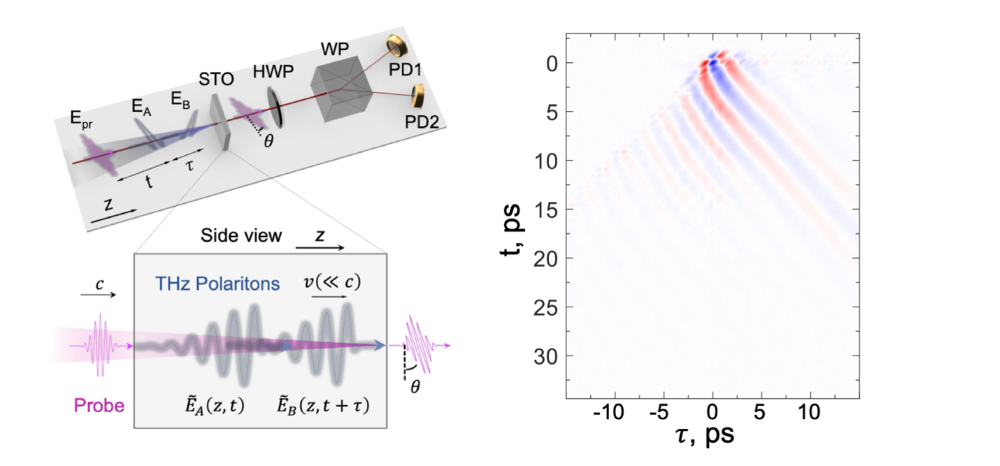
In this work, we identified a previously overlooked mechanism governing charge transport in these materials: networks of flexoelectric domain walls that spontaneously form even in nominally cubic crystals. By developing and combining several advanced experimental techniques, – including electrochemical staining to visualize domain structures and time- and space-resolved two-photon-absorption photocurrent mapping, – we demonstrated that these domain walls act as intrinsic, extended pathways for charge carriers. In their vicinity, carrier recombination is strongly suppressed, while transport is enhanced over long distances.
This finding provides a unified explanation for the long-standing discrepancy between short microscopic lifetimes and efficient macroscopic charge collection in perovskites. More broadly, it establishes flexoelectric domain structures as a new functional element in solid-state systems, with implications extending beyond photovoltaics to charge transport and energy materials in general. The work also introduces a powerful experimental framework for probing local transport phenomena in complex materials, enabling insights that are inaccessible to conventional, spatially averaged measurements. This work was published in Nature Materials: D. Rak et al., Nature Communications 17, 946 (2026).