
Evolutionary Genetics
Biology

Nicholas Barton
Professor
1 Career
- Since 2021 Chair, Institute Committee, Institute of Science and Technology Austria (ISTA)
- 2015 – 2021 Dean, ISTA Graduate School
- Since 2008 Professor, Institute of Science and Technology Austria (ISTA)
- 1990 – 2008 Professor, Institute of Evolutionary Biology, University of Edinburgh
- 1982 – 1989 Lecturer, Department of Genetics, University College London
- 1979 – 1982 Research Fellowship at Girton College, Cambridge University
- 1976 – 1979 PhD, University of East Anglia
- 1973 – 1976 Natural Sciences (Genetics), Cambridge University
1.1 Selected Distinctions
- 2024 Elected Foreign Member, National Academy of Sciences (USA)
- 2023 Mendel medal, Royal Physiographic Society, Lund
- 2016 Senior Editor, Genetics
- 2013 – 2019 ERC Starting Grants panel LS8 (chair from 2016); Consolidator panel since 2026
- 1994 Elected Fellow, Royal Society of London
1.2 Selected Grants
- 2020 – 2023 FWF P-32166 “Snapdragon speciation” with David Field (Edith Cowan Univ., Perth) €399K.
- 2022 – 2027 ERC Advanced Grant 101055327 “Understanding the evolution of continuous genomes” €2.5m.
- 2023 – 2027 FWF SFB “Polygenic adaptation” (with N. Barghi, J. Hermisson, C. Schlötterer, M. Nordborg, H. Sachdeva, K. Swarts). €3.7m.
1.3 Tech Transfer (Patents, Spin-Offs)
N/A
1.4 Selected Publications
- Barton, N.H. 2022. The New Synthesis. Proc. Natl. Acad. Sci. (USA) 119:e2122147119 doi/full/10.1073/pnas.2122147119.
- Surendranadh, P., Arathoon, L., Field, D.L., Pickup, M., Baskett, C.A., Barton, N.H. 2022. Effects
of fine-scale population structure on the distribution of heterozygosity in a long-term study of
Antirrhinum majus. Genetics 221: iyac083 doi.org/10.1093/genetics/iyac083. - Hledik, M., Barton, N.H., Tkacik, G. 2022. Accumulation and maintenance of information in
evolution. Proc. Natl. Acad. Sci. (USA) 119: e2123152119 doi.org/10.1073/pnas.2123152119. - Pal, Arka; Shipilina, Daria; Le Moan, Alan; McNairn, Adrian; Grenier, Jennifer; Kucka, Marek;
Chan, Yingguang; Barton, Nick; Field, David; Stankowski, Sean. 2025 Genealogical analysis of
replicate flower colour hybrid zones in Antirrhinum. Mol. Ecol. 34: 70067 https://doi.org/10.1111/mec.70067. - Shipilina, D., Stankowski, S., Pal, A., Barton, N.H. 2022. On the origin and structure of
haplotype blocks. Molecular Ecology 32: 1441-1457 doi/pdfdirect/10.1111/mec.16793.
2 Group Members
- Sofia Backlund, PhD Student since 2022
- Céline Bräutigam, PhD Student since 2021 (co-affiliated with Gasper Tkacik)
- Ksenia Khudiakova, PhD Student since 2020 (co-affiliated with Jan Maas)
- Hila Lifchitz, PhD Student since 2020 (co-affiliated with Jan Maas & Gasper Tkacik)
- Stepan Ovchinnikov, PhD Student since 2020 (co-affiliated with Calin Guet)
- Evgeniya Pravdolyubova, PhD Student since 2022
- Louise Fouqueau, Postdoc since 2022
- Hilde Schneemann, Postdoc since 2024
- Rosina Soler, Postdoc since 2023
- Benjamin Wölfl, Postdoc since 2023
3 Research
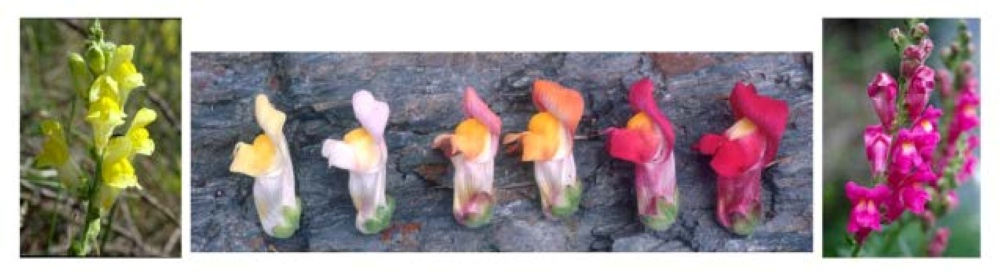
We study diverse topics in evolutionary genetics, but focus on the evolution of populations that are distributed through space, and that experience natural selection on many genes. Our current research centres on a hybrid zone between populations of snapdragon (Antirrhinum majus) that differ in flower colour. We have been sampling the bulk of the population since 2009, using genetic markers to determine relationships; such studies require a long-term commitment, and are thus rare – ours is the largest such study in plants, with >35,000 individuals, and >1000 whole genomes. It provides an opportunity to develop new methods for genomic analysis, and validate them against a population where we have direct direct measurements of individual fitness and dispersal. This empirical work has stimulated theory for understanding how selection acts on very many genes, which may be linked together on linear chromosomes. Specifically, we are investigating the “infinitesimal model” (the basis of practical quantitative genetics); the evolution of gene regulation (using information as a metric); and finding better ways to interpret DNA data (treated as linear sequences, rather than sets of individual sites). We are also studying the self-incompatibility system, which prevents inbreeding; populations maintain many (>30) alternative alleles, each consisting of a tightly linked “supergene” that carries an SRNAse toxin and multiple antitoxins; maintenance of such high diversity for very long timespans poses intriguing evolutionary questions.
3.1 Current Scientific Projects/Directions
- Developing the infinitesimal model for quantitative genetics (with Alison Etheridge, Oxford)
- Understanding how selection and gene flow act on linear chromosomes
- Evolution of gene regulation (with Gasper Tkacik, ISTA)
- Long-term study of a flower colour hybrid zone (with Sean Stankowski, UCL, David Field, Maquarie)
- Evolution of self-incompatibility in Antirrhinum
3.2 Research in Focus
Organisms have evolved large genomes, together with elaborate regulatory systems that express this genome in the appropriate environment and developmental stage. This complexity has evolved through natural selection – that is, through differences in the survival and reproduction of individuals. Although we have well-established theory that explains how selection changes populations, general constraints on how the whole system adapts have been elusive. Miso Hledik, a student coaffiliated with the Barton and Tkacik groups has made two fundamental advances. First, he showed, quite generally, that the rate at which natural selection accumulated information is bounded by the product of population size and the variance in offspring number. Second, he showed that gene regulation will evolve to maximise “free fitness”, which expresses the trade-off between maximising fitness, and minimising the information required. This framing shows how gene regulation can evolve as a collaboration between multiple sites that are each weakly constrained, and suggests new ways to understand the evolution of whole systems.
(Hledik et al., 2022, PNAS; Mascolo et al., 2026, Curr. Op. Gen. Dev.; Barton & Tkacik, 2026, PNAS)

