
Ultrafast Quantum Spectroscopy
Physics

Denitsa Baykusheva
Assistant Professor
1 Career
- Since 2024 Assistant Professor at the Institute of Science and Technology Austria (ISTA)
- 2023 Visiting Scientist, Max Planck Institute for the Structure and Dynamics of Matter, Germany
- 2020 – 2023 Postdoctoral Scholar, Department of Physics, Harvard University, USA
- 2018 – 2020 Postdoctoral Scholar, Stanford PULSE Institute, SLAC National Laboratory, USA
- 2018 PhD, ETH Zürich, Switzerland
- 2013 – 2018 Research Assistant, ETH Zürich, Switzerland
1.1 Selected Distinctions
- 2021 Bronze Talk Prize at the “Low Energy Electrodynamics in Solids” (LEES 2021) conference
- 2021 2nd place Talk Prize at the 11th “New Generation in Strongly Correlated Electron Systems” (NGSCES 2021) conference
- 2020 PostDoc.Mobility Fellowship from the Swiss National Science Foundation
- 2019 Early PostDoc.Mobility Fellowship from the Swiss National Science Foundation
1.2 Selected Grants
- 2025 – 2027 FWF 1000-ideas grant “Towards quantum sensing at ultarafast speeds”. Awarded to RG: € 183,427.
1.3 Tech Transfer (Patents, Spin-Offs)
N/A
1.4 Selected Publications
- D. R. Baykusheva, D. P. Carmichael, C. S. Weber, I-T. Lu, F. Glerean, T. Meng, P. B. M. De Oliveira, Ch. C. Homes, I. A. Zaliznyak, G. D. Gu, M. P. M. Dean, A. Rubio, D. M. Kennes, M. Claassen, M. Mitrano, “Quantum control of Hubbard excitons”, Nat. Mater., (2026).
- J. Hales, U. Bajpai, T. Liu, D. R. Baykusheva, M. Li, M. Mitrano, Y. Wang, “Witnessing Light-Driven Entanglement using Time-Resolved Resonant Inelastic X-Ray Scattering”, Nat. Comm. 14, 3512 (2023).
- D. R. Baykusheva, M. H. Kalthoff, D. Hofmann, M. Claassen, D. M. Kennes, M. A. Sentef, and M. Mitrano, „Witnessing Nonequilibrium Entanglement Dynamics in a Strongly Correlated Fermionic Chain“, Phys. Rev. Lett. 130, 106902 (2023).
- Ch. Heide, Y. Kobayashi, D. R. Baykusheva, D. Jain, J. A. Sobota, M. Hashimoto, P. S. Kirchmann, S. Oh, T. F. Heinz, D. A. Reis, and S. Ghimire, “Probing topological phase transitions using high-harmonic generation”, Nat. Phot. 16, 620 (2022).
- D. R. Baykusheva, H. Jang, A. A. Husain, S. Lee, S. F. R. TenHuisen, P. Zhou, S. Park, H. Kim, J.-K. Kim, H.-D. Kim, M. Kim, S.-Y. Park, P. Abbamonte, B. J. Kim, G. D. Gu, Y. Wang, and M. Mitrano,
“Ultrafast Renormalization of the On-Site Coulomb Repulsion in a Cuprate Superconductor”,
Phys. Rev. X 12, 011013 (2022).
2 Group Members
- Nikola Semenov, PhD Student since 2025
- Phuong Le Hoang, Postdoc since 2025
- Rafael Winkler, Postdoc since 2025
3 Research
Complex collective order in matter, such as superconductivity or magnetism, emerges when a huge number of particles interact to produce macroscopic properties absent at the single-particle level. How such order forms, how it is shaped by fluctuations, and what its spectroscopic fingerprints are form fundamental questions that still remain unanswered.
Our group approaches these questions through photon spectroscopies extending from the terahertz to the x-ray range. We use ultrashort, tailored electromagnetic fields not only to probe complex materials but to drive them into emergent phases beyond equilibrium, realizing, e.g., light-induced ordering or light-matter hybrids. One hallmark of our approach is to connect disciplines traditionally seen as disparate, in particular, ultrafast and quantum optics.
One line we pursue asks how the statistical and correlation properties of light relate to those of collective excitations: can the photon statistics of a drive imprint a signature on the excited many-body state, and conversely, how do the coherence and fluctuations of an ordered phase shape the emitted light? To this end, we develop sources of bright quantum light alongside single-shot, higher-order correlation, and tomography techniques.
A second line brings quantum sensing concepts into ultrafast condensed-matter spectroscopy: by adding femtosecond resolution to existing platforms such as NV centers, or by using material’s own excitations, such as excitons, as intrinsic sensors.
3.1 Current Scientific Projects/Directions
- Terahertz pump-probe sub-wavelength spectroscopy of emergent phases in 2D materials
- Manipulating collective excitations in matter using bright quantum light
- Wigner tomography of harmonic emission in strongly correlated systems
- Time-resolved and ultrafast quantum-sensing using solid-state spins
3.2 Research in Focus
Quantum control of Hubbard excitons in a light-driven Mott insulator
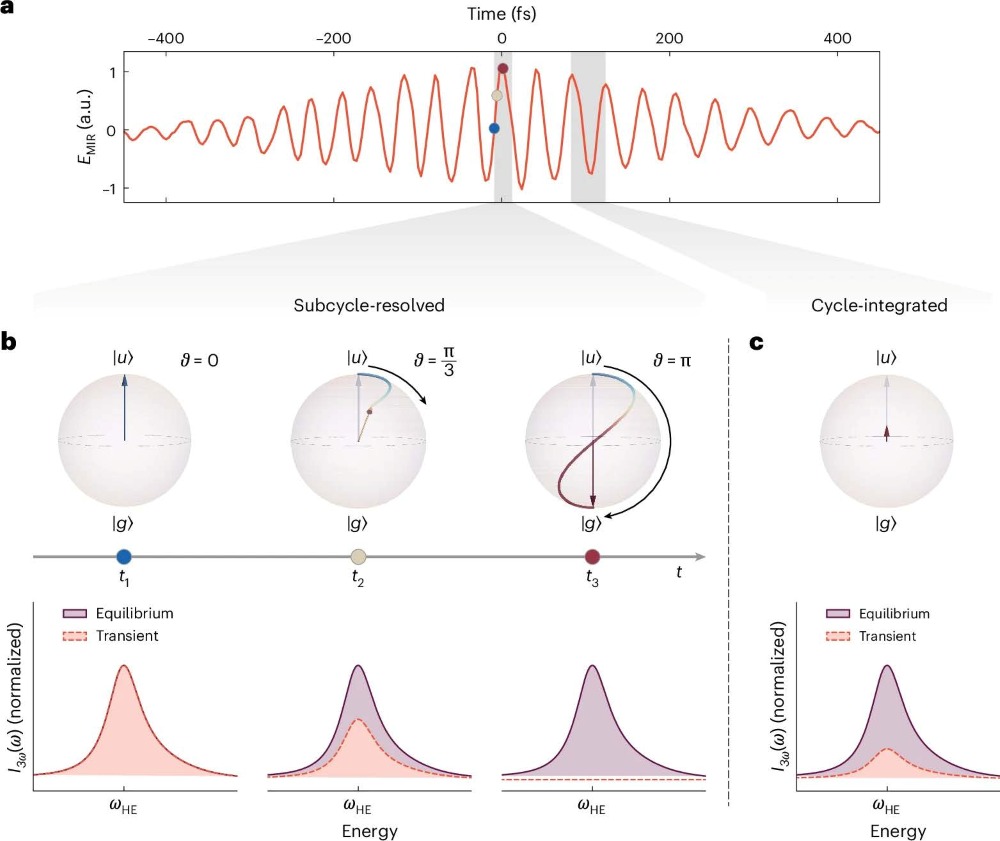
rotation. As the quantum state rotates, the subcycle third-harmonic yield decreases due to changes in the dipole matrix elements, vanishing at 𝜗 = 𝜋. c, The cycle-integrated rotation corresponds to a reduction of the Bloch vector length and a partial suppression of the third-harmonic emission. Figure taken from Nature Materials (2026), https://doi.org/10.1038/s41563-026-02517-6.
Floquet engineering, i.e., the coherent dressing of quantum states by a periodic off-resonant field, has been successfully demonstrated in weakly-correlated systems in the single-particle limit, however, its application to strongly correlated systems has remained elusive. The reason is that the strong interactions lead to congested spectra and fast decoherence channels.
In this work, we demonstrate coherent control of the wavefunction of a many-body electronic state in a quasi-one-dimensional Mott insulator Sr2CuO3. In this system, an electron hopping to an adjacent site creates a doubly-occupied one (doublon) and leaves behind an empty site (holon). Due to the strong Coulomb interaction, the holon and the doublon form a composite bound excitation called Hubbard exciton. The effective one-dimensionality of Sr2CuO3 results a characteristic electronic structure of the Hubbard exciton: two nearly degenerate states of opposite parity, one dark, one bright, forming an effectively isolated two-level system embedded in a correlated solid.
We drive this nearly degenerate exciton pair with intense off-resonant mid-infrared fields. Due to the near degeneracy of the excitonic levels, the energy shift induced by the drive is minimal. Rather, the field mixes their parities. This is read out by resonant third harmonic generation, whose intensity vanishes as the oscillator strength is moved to the dark side. We observe a strong suppression of the harmonic emission when the frequency of the harmonic drive is three-photon resonant with the bright level, and an enhancement upon red-detuning of the drive, indicating the presence of a Floquet sideband. Together, these observations imply coherent sub-cycle rotations on the Bloch sphere spanned by the two excitonic levels by 𝜋/2, in a regime where the light-matter coupling is comparable to the drive frequency.
A rotation of 𝜋/2 represents the minimal building block for multi-pulse protocols such as Ramsey interferometry or dynamical decoupling. These developments could transform the Hubard exciton to a correlated-materials analog of an NV center: an optically addressable two-level system capable of probing the local screening, chemical potential, and correlation dynamics with extreme sensitivity. The concept is readily extendable to other correlated excitons such as Rydberg excitons or magnetically coupled excitons in van-der-Waals antiferromagnets.
This work was published in Nature Materials: D. Baykusheva et al., Nature Materials (2026), https://doi.org/10.1038/s41563-026-02517-6.

