RNA-Based Gene Regulation
Biology

Carrie Bernecky
Assistant Professor
1 Career
- Since 2018 Assistant Professor, Institute of Science and Technology Austria (ISTA)
- 2011 – 2017 Postdoctoral fellow, LMU Munich and MPI for Biophysical Chemistry (now Multidisciplinary Sciences), Germany
- 2010 – 2011 Postdoctoral fellow, University of Colorado, Boulder, USA
- 2010 PhD, University of Colorado at Boulder, Boulder, CO, USA
- 2004 – 2010 Graduate Research and Teaching Assistant, University of Colorado, Boulder, USA
- 2001 – 2004 Undergraduate Research Assistant, Cornell University, USA
- 2004 BA, Cornell University, Ithaca, NY, USA
1.1 Selected Distinctions
- 2027 Invited talk, 71st Annual Meeting of the Biophysical Society
- 2026 Invited Keynote Speaker, FEBS-IUBMB-ENABLE 2026 – The Code of Life: Beyond the Genome to Multilayer Biology
- 2025 Selected talk, CSHL Mechanisms of Eukaryotic Transcription conference; Cold Spring Harbor, NY, USA
- 2025 Invited talk, Microsymposium; Vienna, Austria
- 2019 – 2024 Co-organizer of the annual Vienna-region cryo-EM symposium
1.2 Selected Grants
- 2025 – 2029 European Innovation Council Pathfinder Grant, “Hacking the ribosome to map virus-host associations (VirHoX)”; Grant DOI 10.3030/101186013; Total: € 3,000,000, Group: € 375,315.
- 2024 – 2027 FWF Principal Investigator Project Grant, “Structure and function of the NCoR complex and SETD5”; Grant DOI 10.55776/PAT1270623; € 479,893.
- 2020 – 2028 FWF Special Research Program (SFB), “RNA-DECO: Decorating RNA for a Purpose”; Grant DOI 10.55776/F80; Total: € 10,027,531, Group: € 617,579.
1.3 Tech Transfer (Patents, Spin-Offs)
N/A
1.4 Selected Publications
- K. Tlučková et al., “Mechanism of mammalian transcriptional regulation by noncoding RNA,” Nature Structure and Molecular Biology, vol. 32, no. 4, pp. 607–612, Apr. 2025, issn: 1545-9993. DOI: 10.1038/s41594-024-01448-7. Available: https://doi.org/10.1038/s41594-024-01448-7.
- A. Ramadhin et al., “STK19 drives transcription-coupled repair by stimulating repair complex stability, RNA Pol II ubiquitylation, and TFIIH recruitment,” Molecular Cell, vol. 84, no. 24, pp. 4740-4757.e12, Dec. 2024, issn: 1097-2765. DOI: 10.1016/j.molcel.2024.10.030. Available: https://doi.org/10.1016/j.molcel.2024.10.030.
- D. Zapletal et al., “Structural and functional basis of mammalian microRNA biogenesis by Dicer,” Molecular Cell, vol. 82, no. 21, pp. 4064-4079.e13, Nov. 2022, issn: 1097-2765. DOI: 10.1016/j.molcel.2022.10.010. Available: https://doi.org/10.1016/j.molcel.2022.10.010.
- J. Daiß et al., “The human RNA polymerase I structure reveals an HMG-like transcription factor docking domain specific to metazoans,” Life Science Alliance, vol. 5, no. 11, pp. e202201568, Sep. 2022, issn: 2575-1077. DOI: 10.26508/lsa.202201568. Available: https://doi.org/10.26508/lsa.202201568.
- L.-M. Appel et al., “PHF3 regulates neuronal gene expression through the Pol II CTD reader domain SPOC,” Nature Communications, vol. 12, no. 1, pp. 6078, Oct. 2021, issn: 2041-1723. DOI: 10.1038/s41467-021-26360-2. Available: https://doi.org/10.1038/s41467-021-26360-2.
2 Group Members
- Valentin Leitner, PhD Student since 2021
- Joan Nadia, PhD Student since 2026
- Tereza Tomickova, PhD Student since 2021
- Ljupka Trajkova Petrova, PhD Student since 2026
- Dekel Cohen Hoch, Postdoc since 2024
- Xiu-Li Hou, Postdoc since 2026
- Stefan Riegler, Postdoc since 2026
- Wentao Yang, Postdoc since 2025
- Monika Hrtyan, TA since 2018
3 Research
Gene expression is a fundamental process of life, by which genetic information is transformed into action. RNA is central to this process. RNA is transcribed from DNA, acting both as the information messenger to make proteins and as a ligand to regulate these events. My research group seeks to answer key open questions in transcription regulation and post-transcriptional RNA regulation, especially in the context of innate immunity.
We achieve our goals by studying the structures and biochemical mechanisms of action of the involved complexes. We aim to understand how these complexes assemble and regulate cellular RNA metabolism. Specifically, we study how the essential enzyme RNA polymerase II (Pol II), required for transcribing messenger RNA, is regulated, and how RNA itself regulates these events. Further, we investigate how RNA is co- and post-transcriptionally modified, as well as the molecular consequences of this modification for RNA recognition in the context of innate immunity. Both lines of research study mechanisms that directly feed back into gene transcription, and are heavily influenced by retrotransposon-derived and structured nucleic acids. The mechanisms under study are relevant to human health and disease, including cancer (cell growth and division), innate immunity (especially to RNA viruses), and auto-immune disorders.
3.1 Current Scientific Projects/Directions
- RNA polymerase II complex assembly and nuclear import
- Regulation of mammalian transcription
- RNA recognition in innate immune signaling
- Mapping host-virus association (VirHoX)
3.2 Research in Focus
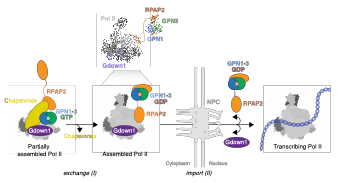
RNA polymerase II (Pol II) must be assembled in the cytoplasm before it enters the nucleus, where it transcribes protein-coding genes. Regulated Pol II assembly and nuclear import are critical for gene expression and its regulation. Although Pol II transcription is intensively studied, how this essential 12-subunit enzyme is made and the role of dedicated assembly factors remains unclear. In recent work, we have carried out integrative structural analysis of a native human Pol II from the cytoplasm captured near the end of biogenesis. High-resolution cryo-EM analysis revealed how two biogenesis-related factors, Gdown1 and RPAP2, chaperone Pol II in the cytoplasm prior to nuclear import. Further biochemical and cryo-EM analysis revealed how RPAP2 anchors the enigmatic but essential small GTPase complex, GPN1–GPN3, to cytoplasmic Pol II. Altogether, these results revealed a GTP-hydrolysis-dependent molecular switch governing biogenesis factor association, and suggested a general mechanism for the action of GPN-loop GTPase family of enzymes. We drew on these results to propose an expanded model for Pol II biogenesis, outlined in Figure 1. This work is available as a preprint (Hlavata et al. bioRxiv 2025), and currently under revision at Nature Communications.