Machine Learning, Computational Imaging, and Sensing
Computer Science

Alexander Bronstein
Professor
1 Career
- Since 2024 Professor, Institute of Science and Technology Austria (ISTA)
- 2021 – 2024 Dan Broida Academic Chair, Technion – Israel Institute of Technology
- 2018 – 2024 Professor, Faculty of Computer Science, Technion (secondary affiliations: Faculty of Biomedical Engineering from 2019; Faculty of Biology from 2023)
- 2016 – 2018 Associate Professor (tenured), Faculty of Computer Science, Technion
- 2013 – 2016 Associate Professor (tenured), School of Electrical Engineering, Tel Aviv University
- 2010 – 2013 Senior Lecturer, School of Electrical Engineering, Tel Aviv University
- 2007 PhD, Computer Science, Technion (Supervisor: Prof. Ron Kimmel)
- 2005 MSc, Electrical Engineering, Technion (summa cum laude)
- 2002 BSc, Electrical Engineering, Technion (summa cum laude)
1.1 Selected Distinctions
- 2024 Abarbanel Prize in Applied Mathematics, Israel Mathematical Union
- 2024 Morton and Beverley Rechler Prize for Excellence in Research, Technion
- 2021 Schmidt Career Advancement Chair in Artificial Intelligence, Technion
- 2020 Fellow, European Laboratory for Learning and Intelligent Systems (ELLIS)
- 2018 Fellow, IEEE — “for contributions to three-dimensional geometric processing in imaging”
- 2018 Best Paper Award, International Conference on 3D Vision (3DV)
- 2016 Best Paper Award, Symposium on Geometry Processing (SGP)
- 2016 Viterbi Career Advancement Chair, Technion
- 2012 Krill Prize for Excellence in Scientific Research, Wolf Foundation
1.2 Selected Grants
- 2025 – 2029 Vienna Science and Technology Fund (WWTF) — Sounds of Silence: Codons and chaperones in the protein folding concert (PI joint with Profs. Clausen and Zuber). €900K.
- 2023 – 2026 Horizon Europe — ThermoBreast: An innovative non-contact and harmless screening modality set to change the course of breast cancer detection and patient monitoring (PI). €650K to RG.
- 2024 – 2028 Israel Science Foundation (ISF) — Data-driven analysis and synthesis tools for applications in life sciences and physics (PI). ILS 862K.
- 2021 – 2026 Israel Council for Higher Education — Model-Based Geometrical Neural Networks: Construction, Applications, and Theory (PI joint with M. Elad and Y. Romano). ILS 1.82M.
- 2020 – 2025 ERC Consolidator Grant — EARS: Acoustics-based drone navigation and interaction (PI). €2M.
- 2019 – 2021 ERC Proof of Concept — DEEP-RADAR: Learning efficient millimeter wave radar imaging for autonomous vehicles (PI). €150K.
- 2015 – 2017 ERC Proof of Concept — NETEEG: Spatial superresolution of electrophysiological measurements (PI). €150K.
- 2013 – 2018 ERC Starting Grant — RAPID: Rapid parsimonious modeling (PI). €1.5M.
1.3 Tech Transfer (Patents, Spin-Offs)
- Co-founder, Invision (2009 – 2012) — acquired by Intel; technology became the basis of Intel RealSense.
- Co-founder and VP Video Technology, Novafora Inc. (2006 – 2009).
- Co-founder and Chief Scientist, Videocites (2015 – 2023; doing business as Ripple Analytics).
- Co-founder and Scientific Advisor, Embryonics (2018 – 2023; acquired by RHEA).
- Co-founder and Chief Scientist, Sibylla (from 2019; doing business as Sibylla Genesis fund).
- Early investor and Scientific Advisor, AKA Foods (2021 – 2024).
- Multiple (~50) issued and pending patents in 3D sensing, computational imaging, and deep-learning hardware.
1.4 Selected Publications
- A. Maddipatla, N. Sellam Bojan, M. Bojan, V. Masalitin, S. Vedula, P. Schanda, A. Marx, A. M. Bronstein. “Experiment-guided AlphaFold3 resolves measurement-consistent protein ensembles,” Nature Biotechnology, accepted, 2026.
- S. A. Maddipatla, N. Bojan Sellam, M. Bojan, S. Vedula, P. Schanda, A. Marx, A. M. Bronstein. “Inverse problems with experiment-guided AlphaFold,” Proc. International Conference on Machine Learning (ICML), 2025.
- A. Maddipatla, A. Rzayev, M. Pegoraro, M. Pacesa, P. Schanda, A. Marx, S. Vedula, A. M. Bronstein. “Inference-time optimization for experiment-grounded protein ensemble generation,” Proc. International Conference on Machine Learning (ICML), 2026.
- M. Bojan, S. Vedula, A. Maddipatla, N. Bojan Sellam, A. Rzayev, F. Napoli, P. Schanda, A. M. Bronstein. “Representing local protein environments with machine learning force fields,” Proc. International Conference on Learning Representations (ICLR), 2026.
- B. Gahtan, A. M. Bronstein. “Wildfire simulation with differentiable Randers-Finsler eikonal solvers,” Proc. Symposium on Geometry Processing (SGP), 2026.
2 Group Members
- Nabin Kumar Sahoo, PhD Student
- Shuqin Zhang, PhD Student
- Shaul Katznelson, Postdoc (co-affiliated with Charles Roques-Carmes)
- Marco Pegoraro, Postdoc
- Anar Sabuxi Oglu Rzayev, Scientific Intern
3 Research
Modern science and technology are increasingly driven by data acquired through complex sensors and by computational models that turn that data into actionable knowledge. The group works at the intersection of machine learning and the physical and life sciences, developing methods that combine learning with physical and geometric models to attack inverse and design problems across a range of domains. A unifying thread runs from computational imaging and sensing — where neural networks are co-designed with the optical, acoustic, or radio-frequency hardware that acquires the data — to biomolecular and chemical sciences, where generative models with physics- or experiment-aware guidance are used to design molecules, predict ensembles of biomolecular conformations, and probe the relationship between sequence, structure, and function. Methodologically, the group emphasises geometric, physics-informed, and equivariant deep learning; end-to-end differentiable design of acquisition systems; and resource-efficient, robust inference. Applications span autonomous perception (radar, sonar, lidar, vision), medical and biological imaging (MRI, ultrasound, microscopy, ECG), drug and material design, structural biology, and quantum optics.
3.1 Current Scientific Projects/Directions
- Guided generative models for biomolecular structure prediction and design
- Inverse molecular and materials design via guided diffusion
- End-to-end differentiable design of computational imaging and sensing systems
- Geometric, physics-informed, and equivariant deep learning
- Inverse design in classical and quantum optics
- Resource-efficient and robust deep learning
- AI for medicine: cardiology, oncology, and prenatal diagnostics
3.2 Research in Focus
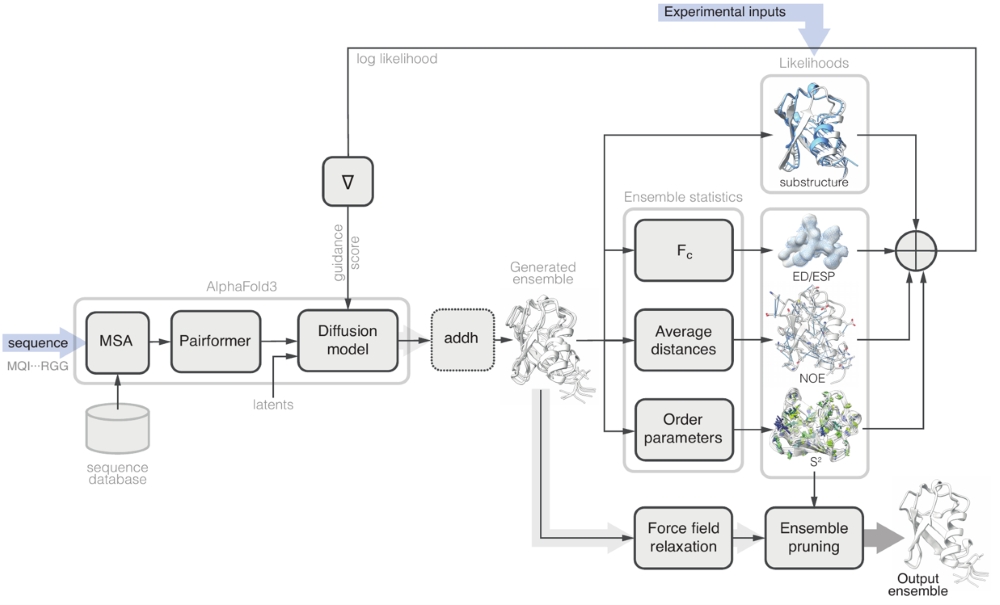
AlphaFold and its successors predict static, single-conformation protein structures with remarkable accuracy. Real proteins, however, are dynamic ensembles, and individual experimental measurements — NMR order parameters and NOE distances, X-ray and cryo-EM densities, partial substructures — each constrain a different statistical aspect of those ensembles rather than any single static structure. The group is developing a guided-AlphaFold framework that turns the AlphaFold3 diffusion sampler into a posterior sampler conditioned on experimental observables. Differentiable likelihood terms for electron density and electrostatic potential maps (ED/ESP), NOE distance restraints, NMR S² order parameters, and known partial substructures are backpropagated through the diffusion trajectory as gradient-based guidance on the score, producing generated ensembles that are simultaneously consistent with the structural prior captured by AlphaFold3 and with the available experimental data, after lightweight force-field relaxation and ensemble pruning. The first paper in this series, Experiment-guided AlphaFold3 resolves measurement-consistent protein ensembles (Maddipatla et al.), has been accepted at Nature Biotechnology (2026); a companion contribution that recasts the problem as inference-time optimisation over AlphaFold3’s latent representations rather than post-hoc perturbation of generated structures — eliminating the dependence on diffusion-trajectory length, removing initialisation bias, and naturally accommodating external constraints — has been accepted at ICML 2026; and a parallel line of work on data-driven priors over local biomolecular environments derived from atomistic foundation-model features (Bojan et al., ICLR 2026) supplies the structural primitives on which these guided generators rely. Together, the three papers turn AlphaFold3 from a structure predictor into a tool for hypothesis-driven, experiment-aware ensemble modelling and design.