
Social Immunity
Biology

Sylvia Cremer
Professor
1 Career
- Since 2015 Professor, Institute of Science and Technology Austria (ISTA)
- 2010 – 2015 Assistant Professor, Institute of Science and Technology Austria (ISTA)
- 2010 Habilitation, University of Regensburg, Germany
- 2006 – 2010 Group Leader, University of Regensburg, Germany
- 2006 Junior Fellow, Institute of Advanced Studies, Berlin, Germany
- 2002 – 2006 Postdoc (Feodor Lynen and Marie Curie), University of Copenhagen, Denmark
- 2002 PhD, University of Regensburg, Germany
1.1 Selected Distinctions
- 2026 Elected Member of the Austrian Academy of Sciences (OeAW; Corresponding Member of the Division of Mathematics and Natural Sciences)
- 2026 Keynote Lecture at the 17th International Conference on Complex Networks (CompleNet, Zaragoza, Spain
- 2025 Seminar at the Zoology Department of the University of Cambridge, UK
- 2024 Seminar in the Friday Lecture Series at Rockefeller University, New York, USA
- 2022 Plenary Lecture at the 19th International Congress of the IUSSI (International Union for the Study of Social Insects), San Diego, USA
1.2 Selected Grants
- 2025 – 2028 FWF Principal Investigator Project, Austrian Science Fund, Antiviral ART in Ants: Avoidance, Resistance and Tolerance in Ants (PAT1534325), Awarded: € 457,629.22.
- 2025 – 2026 Interdisciplinary Project Committee Grant, ISTA:AI-in-the-Loop for Large-scale Ecological DiscoveryALED(IPC64); Co-Investigator: F. Locatello (ISTA), Awarded overall: € 100,000, Awarded to RG: € 50,000.
- 2018 – 2023 ERC Consolidator Grant, European Research Council, Horizon 2020, EPIDEMICSonCHIP: Epidemics in ant colonies On a Chip (771402), Awarded: € 1,991,564.
1.3 Tech Transfer (Patents, Spin-Offs)
N/A
1.4 Selected Publications
- S. Cremer S & M. Sixt “Principles of disease defence in organisms, superorganisms and societies,” Nature Reviews Immunology, vol. 22, pp. 713–714, Oct. 2022, issn: 1474-1741. DOI: 10.1038/s41577-022-00797 [Online]. Available: https://doi.org/10.1038/s41577-022-00797-y.
- M. Stock et al. “Pathogen evasion of social immunity,” Nature Ecology & Evolution, vol. 7, pp. 450–460, Mar. 2023, issn: 2397-334X. DOI: 10.1038/s41559-023-01981-6 [Online]. Available: https://doi.org/10.1038/s41559-023-01981-6.
- B. Casillas-Pérez B et al. Dynamic pathogen detection and social feedback shape collective hygiene in ants. Nature Communications, vol. 14, 3232, Jun. 2023, issn: 2041-1723. DOI: s41467-023-38947 [Online]. Available: https://www.nature.com/articles/s41467-023-38947-y#citeas.
- M. Habig et al., “Frequent horizontal chromosome transfer between asexual fungal insect pathogens,” Proceedings of the National Academy of Sciences. vol. 121, no. 11, e2316284121, Mar. 2024, issn: 1091-6490, DOI: 10.1073/pnas.2316284121 [Online]. Available: https://doi.org/10.1073/pnas.2316284121.
- E.H. Dawson et al., “Altruistic disease signalling in ant colonies,” Nature Communications, vol 16: 10511, Dec. 2025, issn: 2041-1723. DOI: 10.1038/s41467-025-66175 [Online]. Available: https://doi.org/10.1038/s41467-025-66175-z.
2 Group Members
- Lukas Lindorfer, PhD Student since 2023
- Tanvi Madaan, PhD Student since 2024
- David Moreno Martinez, PhD Student since 2024
- Vasudha Kulkarni, PhD Student since 2025
- Michaela Hönigsberger, Postdoc since 2021
- Farnaz Beikzadeh Abbasi, Research Technician, since 2023
- Anna Verena Grasse, Senior Technician/Lab Manager, since 2011
3 Research
Infectious disease can easily spread among closely interacting individuals. Social insects like bees, ants and termites, live in densely-populated nests and engage in extremely close interactions, reflected e.g. by only few workers leaving the nest to forage and then share the food with their colony members via regurgitation. To counteract the risk of disease transmission emerging from this highly social lifestyle, social insects have evolved sophisticated collective and cooperative disease defences, providing social immunity to the colony.
Ants and other social insects regularly disinfect their nest, provide sanitary care by removing infectious particles from pathogen-exposed colony members, and adjust their social interaction networks to disease risk by active social distancing. Their cooperative actions gain additional power as they interplay with the individual immune systems of colony members: caregiving individuals often contract low pathogen levels, which do not cause disease but boost their immune system resulting in reduced future disease susceptibility. Thereby, infection acquired by some individuals becomes ‘distributed between many shoulders’, resp. the individual immune systems of many ants, protecting the colony by herd immunity.
We study social immunity both conceptually, and experimentally in ants, particularly how their social structure and unconditional cooperation caused by reproductive specialization of colony members, shapes colony-wide disease defence.
3.1 Current Scientific Projects/Directions
- Individual and social immunity in social insects
- Collective disease resistance and tolerance
- Epidemiology along social interaction networks
- Pathogen detection and communication of disease
- Disease protection via collective nutrition
3.2 Research in Focus
Social insects form unique social groups: unlike societies, where all group members inherently have equal reproductive potential, social insects express an irreversible reproductive division of labor, fixed during early development: female eggs develop either into queens that will later monopolize egg laying in the colony, or sterile workers that take over brood care and colony maintenance tasks. Hence, individuals in insect colonies express the same germline-soma separation as cells within organisms. Just like a body, a colony thus represents a reproductive entity with the comprising parts being completely dependent on each other for successful production of new colonies resp. bodies. We conceptually derived that the unconditional cooperation expressed both, between cells within organisms, and between organisms within insect colonies, should select for fundamentally similar principles of protection at the level of the respective reproductive entity (Cremer & Sixt 2022 Nat Rev Immunol). Next to cooperative behaviors profiting all colony members, like mutual hygiene, social immunity should therefore also include altruistic components, where the only benefit to the actor lies in protecting colony health, thereby gaining indirect fitness by bringing its own genes into the next generation via supporting kin. Indeed, our experimental work recently documented the existence of altruistic disease signaling in social insects (Dawson et al 2025 Nat Comm). Here we show that infected ant pupae change their body odor, thereby triggering their own destruction by the workers, who slice off their cocoon (Fig. 1), bite pores into their skin, and inject their antimicrobial formic acid-rich poison. Such active alert of the own infection state is reminiscent of the ‘find me an eat me’ signal released by infected body cells attracting immune cells for own removal, revealing the importance of a chemical early warning signal for systemic protection across biological levels.
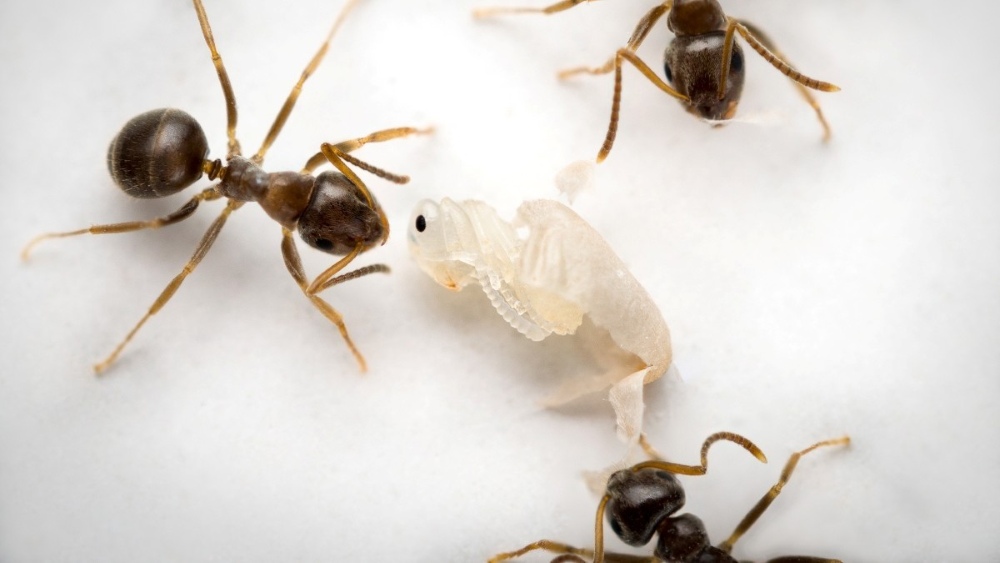
Photo credit: Chris Pull, ISTA.

