
Black Hole Astrophysics and Cosmology
Astronomy

Zoltan Haiman
Professor
1 Career
- Since 2025 Professor, Institute of Science and Technology Austria (ISTA)
- Since 2022 Professor, Department of Physics, Columbia University, USA
- Since 2013 Professor, Department of Astronomy, Columbia University, USA
- 2008 – 2013 Associate Professor, Department of Astronomy, Columbia University, USA
- 2002 – 2007 Assistant Professor, Department of Astronomy, Columbia University, USA
- 1999 – 2002 Hubble Fellow, Department of Astrophysics, Princeton University, USA
- 1998 – 1999 Research Associate, Fermilab Astrophysics Theory Group
- 1993 – 1998 PhD, Astronomy Department, Harvard University, USA
- 1994 – 1995 Certificate of Postgraduate Study, Institute of Astronomy, Cambridge University, UK
- 1989 – 1993 B.S. Physics and B.S. in Electrical Engineering, MIT, USA
1.1 Selected Distinctions
- Since 2025 LISA Science Team (LST), appointed jointly by ESA and NASA
- Since 2024 Editor, Journal of Cosmology and Particle Physics (JCAP)
- 2018 – 2024 LISA Science Group (LSG), ESA board-appointed member
- 2016 Simons Fellowship in Theoretical Physics (Simons Foundation)
- 2010 Blavatnik Award for Young Scientists (New York Academy of Sciences)
1.2 Selected Grants
- 2026 – 2031 ERC Advanced Grant: “Enabling multi-messenger science with black hole binaries” [€ 2,649,807.50].
- 2024 – 2027 NASA Astrophysics Theory Program (ATP): “Realizing the Full Potential of Weak Lensing Cosmology” [$ 647,520.00].
- 2020 – 2025 NSF Astronomy and Astrophysics Research Grants: “Forming the First Massive Black Holes” [$ 775,978.00].
1.3 Tech Transfer (Patents, Spin-Offs)
N/A
1.4 Selected Publications
- C. Xin, M. Isi, W. M. Farr, and Z. Haiman, “Identifying Compact Chirping SMBHBs in LSST Using Bayesian Analysis,” The Astrophysical Journal, vol. 999, no. 1, 149, p. 149, Mar. 2026. DOI: 10.3847/1538-4357/ae40b3. arXiv: 2506.10846 [astro-ph.HE].
- K. Park, Z. Haiman, C. Xin, T. Shen, A. Villar, and J. Davelaar, “Self-lensing flares from black hole binaries. V. Systematic searches in LSST,” Phys. Rev. D, vol. 113, no. 4, 043055, p. 043 055, Feb. 2026. DOI: 10.1103/p328-62sl. arXiv: 2512.08427 [astro-ph.HE].
- A. Lin, M. Charisi, and Z. Haiman, “Lomb-Scargle Periodogram Struggles with Non-sinusoidal Supermassive Black Hole Binary Signatures in Quasar Lightcurves,” The Astrophysical Journal, vol. 997, no. 2, 316, p. 316, Feb. 2026. doi: 10.3847/1538-4357/ae29a7. arXiv: 2505.14778 [astro-ph.HE].
- I. Bartos and Z. Haiman, “Accretion is All You Need: Black Hole Spin Alignment in Merger GW231123 Indicates Accretion Pathway,” The Astrophysical Journal Letters, vol. 996, no. 2, L44, p. L44, Jan. 2026. DOI: 10.3847/2041-8213/ae2bff. arXiv: 2508.08558 [astro-ph.HE].
- M. E. Lee, Z. Haiman, S. Pandey, and S. Genel, “The Effect of Intrinsic Alignments on Weak-lensing Statistics in Hydrodynamical Simulations,” The Astrophysical Journal, vol. 996, no. 1, 36, p. 36, Jan. 2026. DOI: 10.3847/1538-4357/ae1ca7. arXiv: 2504.12460 [astro-ph.CO].
2 Group Members
- Kevin Park, PhD Student since 2025
- Mark Avara, Postdoc since 2025
- David O’Neill, Postdoc since 2025
- Henry Whitehead, Postdoc since 2026
3 Research
Most galaxies have a massive black hole in their nuclei, with masses between a million to a billion solar masses, but their origin remains unknown. Observations have shown that these massive black holes already existed in early times, when the universe was less than a billion years old, possibly pre-dating galaxies.
Galaxies are built up over cosmic time by a series of mergers, which naturally leads to massive black hole mergers, detectable via gravitational waves by the Laser Interferometer Space Antenna (LISA), planned for launch in the mid 2030s.
Galaxies and their black holes form and evolve in a background universe whose expansion has recently sped up. The nature of the ”dark energy” producing this acceleration is unknown, but can be probed statistically through gravitational lensing, which distorts the apparent shapes of galaxies.
My group investigates questions related to the above phenomena through semi-analytic approaches, numerical simulations, and interpreting observations. How and when did the first stars and black holes form in the universe, and what impact did they have on the rest of the universe? Are mergers a major contributor to the growth of black holes, and how do such mergers unfold in galactic nuclei? How can we use observations of gravitational waves and electromagnetic radiation in tandem to answer these questions? Finally, we have been developing new statistical approaches, including machine learning, to use in large forthcoming lensing surveys.
3.1 Current Scientific Projects/Directions
- Hydrodynamical simulations to understand the coupled evolution of binary + disk systems
- Simulations and analytic modeling to understand the electromagnetic emission binary accretion
- Semianalytic models and hydrodynamical simulations of compact objects in quasar accretion disks
- Modeling possible electromagnetic emission from quasar-disk-embedded stellar-mass binaries
- Developing observational tools to search for massive black hole binaries in time-domain surveys
- Addressing systematics in weak-lensing cosmology inference beyond the Gaussian regime
3.2 Research in Focus
In “Self-lensing flares from black hole binaries: observing black hole shadows via light-curve tomography”, with Columbia University postdoc Jordy Davelaar, we followed the radiation emitted by a black hole binary viewed nearly edge-on, including the general relativistic bending of the light paths. The images we produces showed self-lensing flares (SLF) as expected. Furthermore, if the binary orbit is observed nearly edge-on, we found a distinct feature in the light curve imprinted by the black hole shadow from the lensed black hole. We studied this feature by ray-tracing in a binary model and predicted that a few percent of binary candidates could show this feature. The “black hole tomography” method we proposed could make it possible to discover and characterize many black hole shadows in photometric light-curves, that are spatially unresolvable by high-resolution VLBI radio observations. This work was published in Physical Review Letters, vol. 128, 191101 (2022), and was selected as a ”Featured in Physics” focus article, with press releases by the American Physical Society (https://physics.aps.org/articles/v15/68).
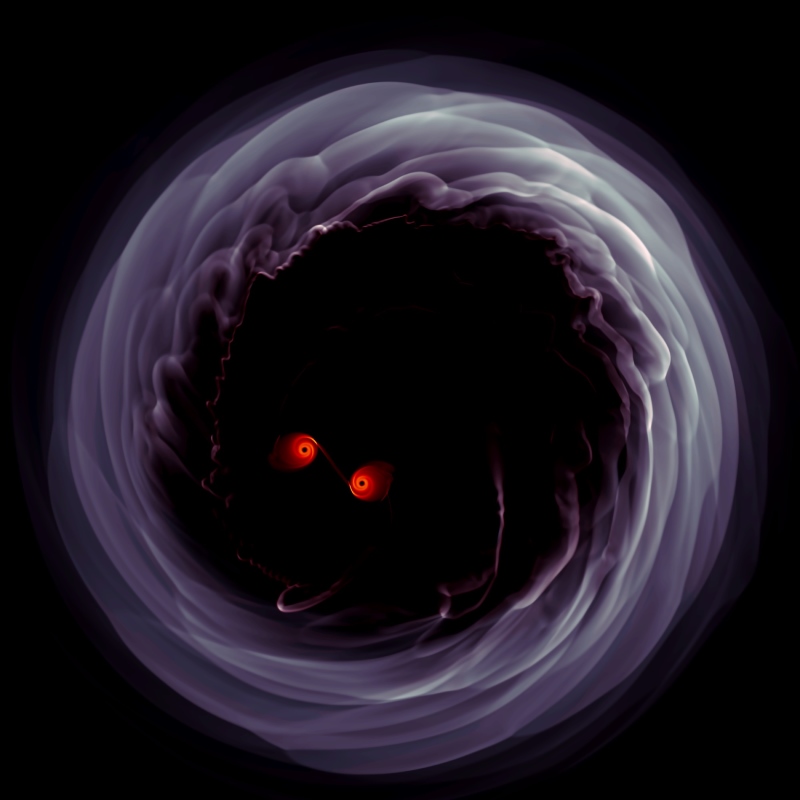
one of our hydrodynamical simulations with the GPU-enabled grid code Sailfish.

