
Geometry and Its Interfaces
Mathematics

Tamas Hausel
Professor
1 Career
- Since 2016 Professor, Institute of Science and Technology Austria (ISTA)
- 2012 – 2016 Professor and Chair of Geometry, EPFL, Lausanne, Switzerland
- 2007 – 2012 Tutorial Fellow, Wadham College, Oxford, UK
- 2007 – 2012 University Lecturer, University of Oxford, UK
- 2005 – 2012 Royal Society University Research Fellow, University of Oxford, UK
- 2002 – 2010 Assistant, Associate Professor, University of Texas, Austin, USA
- 1999 – 2002 Miller Research Fellow, Miller Institute for Basic Research in Science, University of California, Berkeley, USA
- 1998 – 1999 Member, Institute for Advanced Study, Princeton, USA
- 1998 PhD, Trinity College, University of Cambridge, UK
1.1 Selected Distinctions
- 2024 Trinity College Dublin “What is Life?” annual lecture
- 2023 Bourbaki seminar
- 2022 Invited section speaker, International Congress of Mathematicians
- 2021 invited section speaker, International Congress on Mathematical Physics
- 2020 Member of Academia Europaea
1.2 Selected Grants
- 2022 – 2025 FWF Standalone Grant, Geometry of the tip of the global nilpotent cone, € 378K.
- 2026 – 2031 ERC Advanced Grant, Representation theory, equivariant topology and Langlands duality via fixed point schemes, € 2.5M.
1.3 Tech Transfer (Patents, Spin-Offs)
N/A
1.4 Selected Publications
- T. Hausel, “Commutative avatars of representations of semisimple Lie groups,” PNAS 121(38), e2319341121, 2024. DOI: 10.1073/pnas.2319341121.
- T. Hausel and N. Hitchin, “Very stable Higgs bundles, equivariant multiplicity and mirror symmetry,” Inventiones Mathematicae 228, 893–989, 2022.
- T. Hausel, M. Mereb and M. Wong, “Arithmetic and representation theory of wild character varieties,” Journal of the European Mathematical Society 21(10), 2995–3052, 2019.
2 Group Members
- Mischa Elkner, PhD Student
- Daniel Holmes, PhD Student
- Nhok Ngo, PhD Student
- Artem Kalmykov, Postdoc
- Quan Situ, Postdoc
- Olga Trapeznikova, Postdoc
- Aleksandr Zhabin, Postdoc
3 Research
The Hausel group works at the interface of algebraic geometry, topology, representation theory and mathematical physics. We study moduli spaces–especially Higgs bundles, character varieties, quiver varieties and affine Schubert-type spaces–and the structures carried by their cohomology, -theory and enumerative invariants. A recurring theme is that geometric spaces encode symmetries: Langlands duality, mirror symmetry, integrable systems, quantum groups and representation-theoretic bases become visible through topology and algebraic geometry. The group combines conceptual theory with explicit computation and visualization, using examples, arithmetic point counts and computer-assisted models to test conjectures and communicate high-dimensional geometry. Recent work includes very stable Higgs bundles and mirror symmetry, arithmetic and representation theory of wild character varieties, and the new theory of big algebras.
3.1 Current Scientific Projects/Directions
The ERC Advanced Grant (2026–2031) seeks a three-way dictionary between representation theory, equivariant topology and Langlands duality, read off fixed point schemes. We pursue it with Project Sandbox, which we built for this purpose in 2026: each theory is developed in its own sandbox, with a computational instrument (Julia/OSCAR) and a formal one (Lean), by AI agents that we direct, and each dictionary becomes a bridge between two sandboxes. Results so far:
- The first sandbox, on newly defined hybrid quantum groups, has produced 242 candidate papers, 39 preprints in its own series, 70,000 lines of Julia and 160,000 of Lean (October 2026). Its flagship conjecture
now has two proofs by different methods, refereed but not yet adopted. Candidate results pass internal refereeing (over 50 referee reports so far) before anything is published. - The pilot almanac almanacA0a (September 2026, DOI: 10.5281/zenodo.22808195) publishes one result, the centre of the even hybrid family for quantum , in three layers joined claim by claim: the proof, the Julia instrument and a machine-checked Lean development.
- Bridges: with Löwit and Ngô, quantum groups and affine Hecke algebras model the equivariant -theory of affine Grassmannians and Schubert varieties. András Szenes (Geneva) joined in September with a sandbox on quantum Verlinde algebras, whose Bethe loci we compare with discriminants of big algebras.
- Ilona Tylevna’s three-month internship with M. Sammler and me (overview) produced Juliatolean, a translator from Julia to Lean 4 run on pieces of our own package, and Pólya’s theorem in Lean 4: integer-valued polynomials are exactly the -linear combinations of binomial-coefficient polynomials. New course: AI for Mathematics (with M. Kwan), autumn 2026.
Two proposals submitted in September 2026 would extend the model: an ERC Proof of Concept for certified editions, and, with M. Serbyn and M. Sammler, a NOMIS–ISTA Pioneer Award concept that brings it to physics.
3.2 Research in Focus
In the 2024 PNAS paper Commutative avatars of representations of semisimple Lie groups, I introduced “big algebras”: commutative geometric avatars attached to non-commutative matrix representations of complex semisimple Lie groups. The construction replaces an algebra whose multiplication is difficult to see geometrically by a finite flat commutative algebra over equivariant cohomology. The main theorem identifies these algebras with equivariant intersection cohomology of affine Schubert varieties, giving the latter new ring structures. In this form, refined representation-theoretic data–weight multiplicities, crystal-like structures, and affine Kazhdan–Lusztig/Lusztig q-weight information–can be approached with algebraic geometry.
This stands out because it is both conceptual and computable. It turns a long-sought dictionary between symmetry, geometry, and representation theory into an explicit two-way translation, and suggests new contact with Langlands duality and mathematical structures from quantum physics.
The project also had unusual outreach resonance. ISTA presented it as “a dictionary of abstract math”; Der Standard covered it as a view into the hidden depths of the “mathematical iceberg”; and the accompanying computational/visual material was selected as a Wolfram Community Staff Pick. The figures and 3D-printable surfaces, skeletons, and nerves are collected in the Hausel group mathematical zoo. The models were designed by rotation student Daniel Bedats, now in the Wagner group, and 3D printed on ISTA’s J850™ Digital Anatomy™ 3D Printer in the machine shop with the assistance of Todor Asenov.
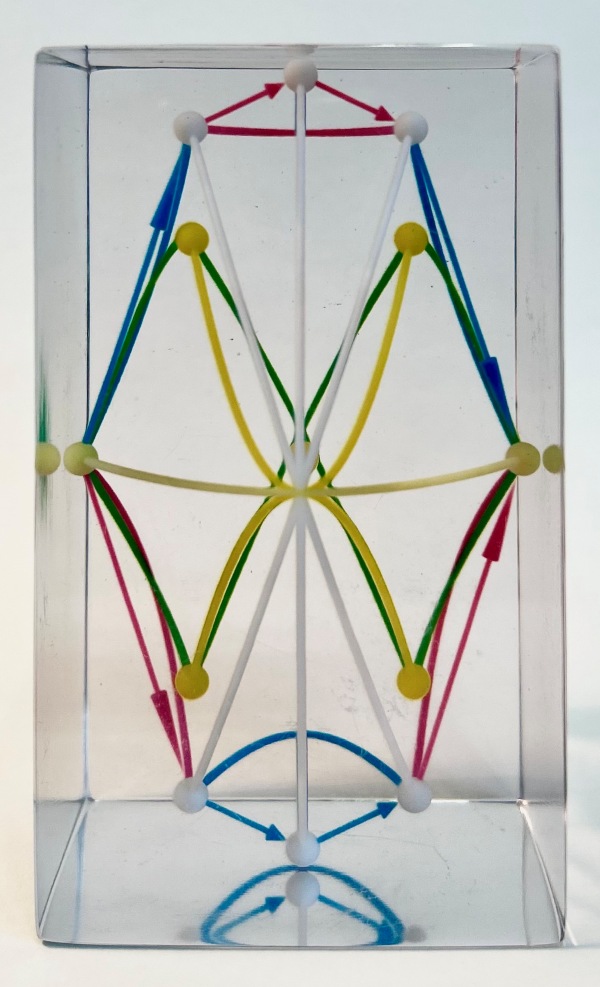
Source: T. Hausel, “Commutative avatars of representations of semisimple Lie groups,” Proceedings of the National Academy of Sciences of the USA 121(38), e2319341121, 2024. DOI: 10.1073/pnas.2319341121.

