
Theoretical Atomic, Molecular, and Optical Physics
Physics

Mikhail Lemeshko
Professor
1 Career
- Since 2019 Professor, Institute of Science and Technology Austria (ISTA)
- 2014 – 2019 Assistant Professor, Institute of Science and Technology Austria (ISTA)
- 2011 – 2014 ITAMP Postdoctoral Fellow, Harvard University, Cambridge, USA
- 2011 PhD, Fritz Haber Institute of the Max Planck Society, Berlin, Germany
1.1 Selected Distinctions
- 2024 Organizer, Cold and Controlled Molecules and Ions Conference at ISTA
- 2020 Elected Member, Young Academy of the Austrian Academy of Sciences
- 2017 Ludwig Boltzmann Prize, Austrian Physical Society
1.2 Selected Grants
- 2024 – 2028 SFB Grant together with the groups of Heckl (Uni Vienna), Schumm, Baltuska (TU Vienna), Palffy-Buß (Uni Würzburg) “Coherent Optical Metrology Beyond Electric-Dipole-Allowed Transitions”, € 713,339 (2024 – 2028 + potential 4 year extension), € 3.6 M in total.
- 2019 – 2024 ERC Starting grant “Angulon: physics and applications of a new quasiparticle”.
1.3 Tech Transfer (Patents, Spin-Offs)
N/A
1.4 Selected Publications
- M. Hrast, G. M. Koutentakis, M. Maslov, M. Lemeshko, “Bottom-up Analysis of Rovibrational Helical Dichroism,” Physical Review Letters, vol. 136, no. 5, pp. 053204, Feb. 2026, issn: 1079-7114. DOI: 10.1103/fkf1-1jml. [Online]. Available: https://doi.org/10.1103/fkf1-1jml.
- F. Kluibenschedl, G. M. Koutentakis, R. Alhyder, M. Lemeshko, “Domain-Wall Ferroelectric Polarons in a Two-Dimensional Rotor Lattice Model,” Physical Review Letters, vol. 134, no. 9, pp. 096302, Mar. 2025, issn: 1079-7114. DOI: 10.1103/PhysRevLett.134.096302. [Online]. Available: https://doi.org/10.1103/PhysRevLett.134.096302.
- M. Maslov, G. M. Koutentakis, M. Hrast, O.H. Heckl, M. Lemeshko, “Theory of angular momentum transfer from light to molecules”, Physical Review Research, vol. 6, no. 3, pp. 033277, Sep. 2026, issn: 2643-1564. DOI: 10.1103/PhysRevResearch.6.033277. [Online]. Available: https://doi.org/10.1103/PhysRevResearch.6.033277.
- L. Kranabetter et al., “Nonadiabatic laser-induced alignment dynamics of molecules on a surface”, Physical Review Letters, vol. 131, no. 5, pp. 053201, Aug. 2023, issn: 1079-7114. DOI: 10.1103/PhysRevLett.131.053201. [Online]. Available: https://doi.org/10.1103/PhysRevLett.131.053201.
- V. Karle, A. Ghazaryan, M. Lemeshko, “Topological charges of periodically kicked molecules”, Physical Review Letters, vol. 130, no. 10, pp. 103202, Mar. 2023, issn: 1079-7114. DOI: 10.1103/PhysRevLett.130.103202. [Online]. Available: https://doi.org/10.1103/PhysRevLett.130.103202.
2 Group Members
- Florian Kluibenschedl, PhD Student since 2022
- Gulnaz Rakhmanova, PhD Student since 2023
- Palina Shaban, PhD Student since 2023
- Ragheed Al Hyder, Postdoc since 2023
- Baptiste Coquinot, Postdoc since 2024
- Mateja Hrast, Postdoc since 2023
- Volker Karle, Postdoc since 2019
- Georgios Koutentakis, Postdoc since 2022
- Jinglun Li, Postdoc since 2025
- Mikhail Maslov, Postdoc since 2018
3 Research
The Lemeshko group develops theory to understand quantum few- and many-particle phenomena involving molecules, electrons and light. Most of what we study lies at the interface of AMO, solid-state, and chemical physics, where we often develop new theoretical tools to keep pace with experimental advances.
Examples of the systems we are working on range from the electronic properties of lead-halide perovskites and metal-organic frameworks, to topological phenomena in periodically kicked molecules, chirality-magnetism connections, and emergent phenomena in ultracold molecular gases. We are closely collaborating with experimentalists both at ISTA (Alpichshev, Leonard, Hosten, Fink) and internationally.
3.1 Current Scientific Projects/Directions
- Spectroscopy of molecules using structured light
- Electronic properties of lead-halide perovskites
- Chirality-magnetism connections and chirality-induced spin selectivity
- Quantum dynamics of molecules in superfluids
- Properties of periodically kicked molecules
- Many-body physics of ultracold gases
3.2 Research in Focus
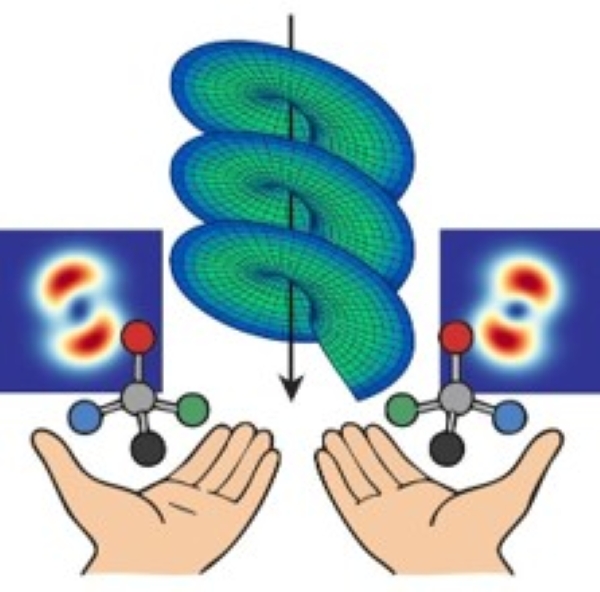
Many biologically important molecules exist as mirror-image pairs called enantiomers. A striking example is methamphetamine: its R-enantiomer is a common nasal decongestant, while the S-enantiomer is the psychoactive substance behind addiction epidemics. Telling these two forms apart — reliably and cost-effectively — remains a genuine technical challenge in the pharmaceutical industry.
One promising approach uses helical dichroism (HD), the differential absorption of twisted light carrying orbital angular momentum (OAM), see Fig. 1. However, the microscopic origin of HD had remained unclear and several experimental claims were contested. In a paper published in Physical Review Letters 136, 053204 (2026), the Lemeshko group developed a rigorous theoretical framework for HD in rovibrational spectroscopy, resolving these ambiguities from first principles.
The central finding is that paraxial vortex beams cannot produce genuine HD — any dichroism they generate reduces to conventional circular dichroism, with no OAM actually transferred to the molecule. Genuine HD requires the spin-orbit coupling (SOC) of light, which arises in tightly focused beams. Most strikingly, even a plain Gaussian beam carrying no OAM in the far field can produce genuine HD once sufficiently focused. The framework also derives rotational selection rules that allow prior experiments to be reinterpreted, and offers a roadmap for designing future chiral-sensing experiments with structured light.

