
Quantum Optics
Physics

Julian Léonard
Assistant Professor
1 Career
- Since 2024 Assistant Professor, Institute of Science and Technology Austria (ISTA)
- 2021 – 2024 Assistant Professor, Department of Physics, TU Wien
- 2017 – 2021 Postdoctoral fellow, Department of Physics, Harvard University, USA; faculty advisor: Markus Greiner, Professor of Physics
- 2011 – 2017 PhD student, Department of Physics, ETH Zürich, Switzerland; thesis advisor: Tilman Esslinger, Professor of Physics
- 2010 – 2011 M.Sc. in Physics, ENS Paris and Sorbonne Université, Paris, France; thesis advisor: Jean Dalibard, Professor of Physics
1.1 Selected Distinctions
- 2026 Organizer of the Atomic Quantum Matter conference, ISTA
- 2024 Cardinal Innitzer Award for best Austrian Habilitation in physics
- 2022 Organizer of the Frontiers of Quantum Gas Microscopy Workshop, Bad Honnef
1.2 Selected Grants
- 2026 – 2030 FWF SFB Neutral-atom quantum systems with high connectivity, co-investigators: Thomas Pohl (TU Wien, lead), Hannes Bernien (IQOQI), Annabelle Bohrdt (LMU), Francesca Ferlaino (IQOQI), Tim Langen (TU Wien), Andreas Nunnenkamp (Uni Wien), Hannes Pichler (IQOQI). Awarded overall: € 4,080,987.32, awarded to RG: € 520,100.65.
- 2023 – 2028 ERC StG Non-abelian anyons in programmable lattices. Awarded: € 1,499,334.
- 2021 – 2027 FWF START Quantum Optimization with an atom-light simulator. Awarded: € 1,200,000.
1.3 Tech Transfer (Patents, Spin-Offs)
- 2021 – 2027 XISTA Fellowship for tech transfer of fiber-integrated light-matter interfaces; awarded to Maximilian Prüfer, Postdoc in my research group
1.4 Selected Publications
- J. Léonard, S. Kim, J. Kwan, P. Segura, F. Grusdt, C. Repellin, N. Goldman, and M. Greiner, Realization of a fractional quantum Hall state with ultracold atoms, Nature 619, 495 (2023).
- J. Léonard, M. Rispoli, A. Lukin, R. Schittko, S. Kim, J. Kwan, D. Sels, E. Demler, and M. Greiner, Probing the onset of quantum avalanches in a many-body-localized system, Nature Physics 19, 481 (2023).
- A. Bohrdt, S. Kim, A. Lukin, M. Rispoli, R. Schittko, M. Knap, M. Greiner, and J. Léonard, Analyzing non-equilibrium quantum states through snapshots with artificial neural networks, Phys. Rev. Lett. 127, 150504 (2021).
- M. Rispoli, A. Lukin, R. Schittko, S. Kim, M. E. Tai, J. Léonard, and M. Greiner, Quantum critical behaviour at the many-body localization transition, Nature 573, 385 (2019).
- A. Lukin, M. Rispoli, R. Schittko, M. E. Tai, A. M. Kaufman, S. Choi, V. Khemani, J. Léonard, and M. Greiner,Probing entanglement in a many-body-localized system, Science 364, 256-260 (2019).
2 Group Members
- Stephan Roschinski, PhD Student since 2022
- Johannes Schabbauer, PhD Student since 2023
- Isabelle Safa, PhD Student since 2023
- Saumya Shah, PhD Student since 2025
- Franz von Silva-Tarouca, PhD Student since 2024
- Sarah Waddington, PhD Student since 2023
- Damien Bloch, Postdoc since 2025
- Maximilian Prüfer, Postdoc since 2026
- Rodrigo Rosa-Medina, Postdoc since 2024
3 Research
Studying the quantum world of small particles and the forces that govern their behavior has proven difficult for even our most powerful supercomputers. The Léonard group seeks to gain insight into this world by studying quantum optical systems built of individually controlled atoms and photons. This could help improve materials and develop applications in quantum computing and quantum information processing.
Using arrangements of laser beams, the group cools dilute atomic gases to nanokelvin temperatures, near absolute zero. The experimental control achieved over these ultracold atoms is unique within experimental physics: it is possible to control their motional and electronic states, to arrange them in programmable patterns, and tune their interaction strength. The Léonard group combines the tools of atomic and optical physics to trap ultracold atoms in tailored optical potentials, such as optical tweezer arrays and optical lattices. This allows them to reach single-particle quantum control and readout of large numbers of atoms, providing a path for scalable quantum computing and simulation.
3.1 Current Scientific Projects/Directions
- Coupling an atomic tweezer array to an optical cavity
- Fermionic arrays for quantum simulation
- Fiber Fabry-Pérot cavities for quantum networks
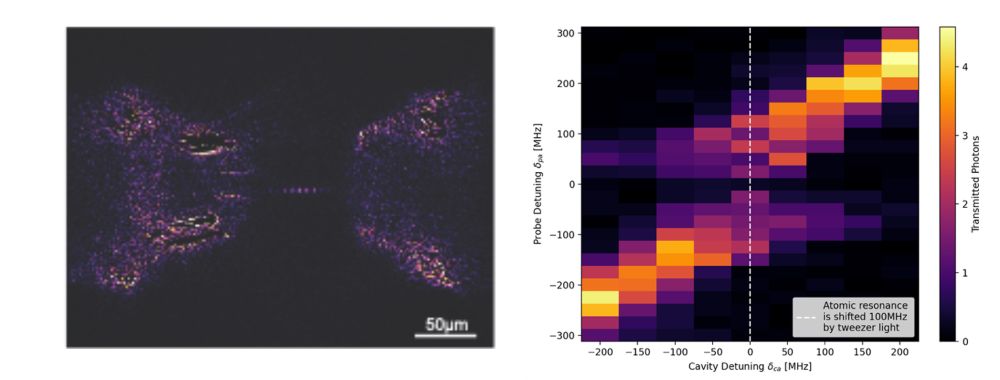
Right: Transmission spectrum of the cavity containing a single rubidium atom positioned at the antinode of the cavity mode.
3.2 Research in Focus
As neutral-atom arrays mature into powerful quantum processing units, the central bottleneck to large-scale quantum computing is shifting from local control to scalable nonlocal connectivity. Nonlocal connectivity enables the implementation of more efficient quantum algorithms, and it replaces the currently employed shuttling, which costs time, coherence, and routing complexity. In addition, further scaling requires a modular architecture with high-performance optical interconnects between different modules or distant locations within the same module. Photons can distribute entanglement across long distances, providing the resource required for fast nonlocal gates, entanglement swapping, and teleportation-based operations; yet state-of-the-art interconnects remain largely elementary. A central challenge is to merge high coupling of the atoms to the light field with high optical access for single-atom control.
In our lab, we have coupled an atomic array with a microscopic optical cavity. The cavity is engineered out of optical fibers, which yields small mode volumes for strong coherent atom light couplings with Purcell factors of several hundreds, while maintaining a large numerical aperture for high-resolution imaging. A set of focused laser beams hold the atoms in a one-dimensional array with high-fidelity single-atom control and readout. We control the atomic qubit state with a pair of Raman beams, we tune the coupling to the optical cavity by the atomic position with respect to the cavity mode, and we read out the state with mid-circuit measurements via the cavity transmission. As the number of tweezers is increased, we observe the emergence of collective coupling to the optical cavity. In future, we want to use this coupling to engineer atom-atom and atom-photon entanglement in the system. This establishes our platform as a promising candidate for quantum computing and networking. Publication in preparation.

