
Astrophysics of Galaxies
Astronomy

Jorryt Matthee
Assistant Professor
1 Career
- Since 2023 Assistant Professor, Institute of Science and Technology Austria (ISTA)
- 2018 – 2023 Zwicky Postdoctoral Prize Fellow, ETH Zürich, Switzerland
- 2014 – 2018 PhD, Leiden University, the Netherlands
1.1 Selected Distinctions
- 2020 MERAC Prize for best PhD Thesis in Observational Astrophysics
- 2018 IAU PhD Prize, Division J Galaxies and cosmology, International Astronomical Union
- 2018 C.J. Kok Jury Award, Best PhD thesis, Science Faculty, Leiden University
1.2 Selected Grants
- 2026 – 2030 ‘Dark Universe Explorations (DUNE)’, Special Research Area, Austrian Science Fund FWF, Coordinator: T. Schrabback (University of Innsbruck). Awarded overall: € 3,249,921.87, awarded to RG: € 370,419.71.
- 2023 – 2028 ‘Young galaxies as tracers and agents of cosmic reionization’ (AGENTS), ERC Starting Grant: € 1,498,216.
- 2023 – 2025 ‘Witnessing galaxies’ birth with JWST spectroscopy’, MERAC foundation: € 100,000.
- Since 2023 111 hours on the NASA/ESA/CSA James Webb Space Telescope as PI.
- Since 2017 ∼300 hours on the ESO Very Large Telescope as PI.
1.3 Tech Transfer (Patents, Spin-Offs)
N/A
1.4 Selected Publications
- J. Matthee et al., “Little Red Dots: An Abundant Population of Faint Active Galactic Nuclei at z ∼ 5 Revealed by the EIGER and FRESCO JWST Surveys,” The Astrophysical Journal, vol. 963, no. 2, p. 129, Mar. 2024, Art. no. 129. DOI: 10.3847/1538-4357/ad2345. arXiv: 2306.05448 [astro-ph.GA].
- J. Matthee et al., “EIGER. II. First Spectroscopic Characterization of the Young Stars and Ionized Gas Associated with Strong Hβ and [O III] Line Emission in Galaxies at z = 5-7 with JWST,” The Astrophysical Journal, vol. 950, no. 1, p. 67, Jun. 2023, Art. no. 67. DOI: 10.3847/1538-4357/acc846. arXiv: 2211.08255 [astro-ph.GA].
- A. Torralba et al., “The warm outer layer of a little red dot as the source of [Fe II] and collisional Balmer lines with scattering wings,” Astronomy & Astrophysics, vol. 707, A75, Feb. 2026, Art. no. A75. DOI: 10.1051/0004-6361/202557537. arXiv: 2510.00103 [astro-ph.GA].
- J. Matthee, “JWST provides a new view of cosmic dawn: latest developments in studies of early galaxies,” Contemporary Physics, vol. 66, no. 1-4, pp. 116–151, Oct. 2025. DOI: 10.1080/00107514.2025.2586370. arXiv: 2511.04843 [astro-ph.GA].
- C. Di Cesare et al., “The slope and scatter of the star-forming main sequence at z ∼ 5: Reconciling observations with simulations,” Astronomy & Astrophysics, vol. 707, A129, Mar. 2026, Art. no. A129. DOI: 10.1051/0004-6361/202557790. arXiv: 2510.19044 [astro-ph.GA].
2 Group Members
- Gauri Kotiwale, PhD Student since 2023
- Ivan Kramarenko, PhD Student since 2023
- Benjamin Navarrete, PhD Student since 2024
- Claudia Di Cesare, Postdoc since 2024
- Edoardo Iani, Postdoc (ISTA Fellow) since 2025
- Sara Mascia, Postdoc (ISTA Fellow) since 2024
- Alberto Torralba, Postdoc since 2025
3 Research
Galaxies such as our own Milky Way are the largest bound structures in our Universe and consist of gas, stars, planets, black holes and dark matter. The astrophysical processes that occur in galaxies happened to every atom in our body and therefore fundamentally teach us about our own cosmic origins. The Matthee group investigates how galaxies form and evolve using observations of the very distant Universe with powerful telescopes as the ESO Very Large Telescope (VLT) and the NASA/ESA/CSA James Webb Space Telescope (JWST). The observational data obtained with these facilities is interpreted using radiative transfer models, models of stellar populations and by comparing to results from large computer simulations of galaxy formation.
The research in the Matthee group focuses on four themes: star formation in the early Universe, the sources of cosmic reionization, the metal-enrichment process in and around early galaxies and the emergence of super massive black holes. The primary techniques that we use are optical-near-infrared imaging, echelle, fiber, slitless and integral field spectroscopy in the optical to near-infrared with instruments as NIRCam and NIRSpec (JWST) and X-SHOOTER, FLAMES and MUSE (VLT).
3.1 Current Scientific Projects/Directions
- Characterizing the star formation rate history of the Universe, primarily using the ALT survey of galaxies magnified by strong lensing clusters [Di Cesare, Kramarenko, Iani].
- Probing the chemical enrichment history of galaxies using various abundance measurements in distant galaxies with JWST spectroscopy [Kotiwale, Di Cesare, Navarrete].
- Probing the formation and growth of the first (super)massive black holes in the early Universe with population-level studies as well as radiative transfer models [Torralba, Kapoor, Iani, Catone, Mascia].
- Assessing the role of galaxies driving cosmic reionization by inferring the galaxy emissivity based on our understanding of ionizing photon production and escape, as well as cross-correlations between galaxy over-density and the state of the intergalactic medium [Mascia, Navarrete].
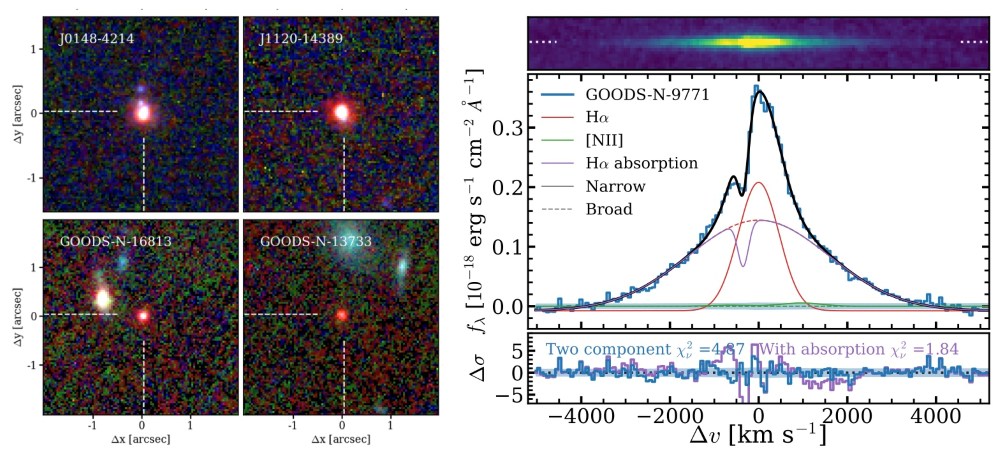
3.2 Research in Focus
The main scientific highlight is the discovery and characterization of a newly-identified population of sources that are remarkably abundant in images with the JWST, the so-called Little Red Dots (Fig. 1). My paper (Matthee et al. 2024, ApJ, 963, 129; among the top 10 cited papers in astronomy of 2024 and the most highly cited paper based on JWST data; 700 citations as of April 2026) provided the first systematic identification of these sources based on spectroscopy, provided the first basic measurements as their number density and identified the first Balmer absorption lines that now appear to be key in the interpretation of these sources. The paper also introduced the now commonly adopted name and led to various follow-up projects (observing time allocations on the JWST and VLT as PI and as co-I), four papers from my group (Matthee et al. 2025, Torralba et al. 2025, 2026a, 2026b) and more than twenty co-authored publications with international collaborators. The interpretation of what these objects are remains debated (see recent CNN interview). Most groups agree that they are likely powered by accreting massive black holes and therefore these sources could be the predecessors of luminous quasars and represent a previously unidentified phase in the formation of supermassive black holes that are present in virtually every massive galaxy. However, the sources lack various features typically associated with accretion onto black holes, while also showing spectral features typically associated with stellar phenomena as outbursts in luminous blue variables or Type IIn supernovae. This suggests that alternative explanations such as supermassive stars or quasi-stars – theoretically hypothesized phenomena for which it is unclear whether they actually occur in nature – are still considered.

