Cryosphere and Mountain Hydrosphere
Earth Science

Francesca Pellicciotti
Professor
1 Career
- Since 2023 Professor, Institute of Science and Technology Austria (ISTA)
- 2018 – 2023 Group Leader, Swiss Federal Institute for Forest, Snow and Landscape Research, Switzerland
- 2015 – 2022 Associate Professor, Northumbria University, UK
- 2013 – 2015 Visiting Scientist, ICIMOD, Kathmandu, Nepal
- 2007 – 2014 Senior Researcher, ETH Zurich, Switzerland
- 2004 – 2007 Postdoctoral research associate, ETH Zurich, Switzerland
- 2000 – 2004 PhD Environmental Engineering, ETH Zurich, Switzerland
1.1 Selected Distinctions
- Since 2026 Associate Lead of Working Group on Actionable Cryosphere Projections for the Decade of Action for Cryospheric Science
- 2020, 2022, 2024, 2026 ERC Consolidator Panel Member
- 2019 Convener, Debris-covered glaciers session at IUGG in Montreal
- 2018 – 2024, Chair, IACS Working Group on Debris-covered glaciers
- 2018 – 2022, Scientific Editor, The Cryosphere
1.2 Selected Grants
- 2026 – 2031 Schmidt Sciences, Virtual Institute for Earth’s Water (VIEW). Water from the mountains: global re-analysis and future tipping points. Coordinator: Francesca Pellicciotti (ISTA Collaborators: Locatello and Fatichi Groups). Awarded overall: 9,5 million USD (€ 8,162,178), awarded to RG: 3,3 million USD.
- 2022 – 2026 Swiss Polar Institute (SPI) Flagship Initiative (SPI-FLAG-2021-001). From ice to microorganisms and humans: Toward an interdisciplinary understanding of climate change impacts on the Third Pole. Coordinator: Francesca Pellicciotti. Awarded overall: CHF 1,5 million CHF, awarded to RG: € 505,000.
- 2022 – 2026 Swiss National Science Foundation (SNSF) (grant no. 204322), RENOIR: “Resolving the thickness of debris on Earth’s glaciers and its rate of change”. PI. Awarded overall: € 766,000, awarded to RG: € 766,000.
1.3 Tech Transfer (Patents, Spin-Offs)
N/A
1.4 Selected Publications
- Pellicciotti F, Fontrodona-Bach A, et al. DCG-MIP: The debris-covered glacier melt model intercomparison experiment. The Cryosphere. 20(3), 1895–1928 (2026). https://doi.org/10.5194/tc-20-1895-2026.
- Ayala Á et al. Less water from glaciers during future megadroughts in the Southern Andes. Communications Earth and Environment. 6, 860 (2025). https://doi.org/10.1038/s43247-025-02845-6.
- Shaw T et al. Mountain glaciers recouple to atmospheric warming over the twenty-first century. Nature Climate Change. 15, 1212–1218 (2025). https://doi.org/10.1038/s41558-025-02449-0.
- Fyffe C L et al. Thin and ephemeral snow shapes melt and runoff dynamics in the Peruvian Andes, Communications Earth and Environment 6 (2025). https://doi.org/10.1038/s43247-025-02379-x.
- Jouberton A et al. Snowfall decrease in recent years undermines glacier health and meltwater resources in the Northwestern Pamirs. Communications Earth and Environment. 6, 691 (2025). https://doi.org/10.1038/s43247-025-02611-8.
2 Group Members
- Joshua Castro, PhD Student since 2022 (remained in Switzerland; still supervised)
- Haruki Hagiwara, PhD Student since 2023
- Vicente Melo Velasco, PhD Student since 2023
- Evgeny Tumarkin, PhD Student from 2026
- Adrià Fontrodona-Bach, Postdoc since 2023
- Catriona Fyffe, Postdoc since 2023
- Prateek Gantayat, Postdoc since 2024
- Jose Munos Hermosilla, Postdoc since 2024
- Maximiliano Rodriguez Moreno, Postdoc since 2025
- Shaoting Ren, Postdoc since 2024
- Yota Sato, Postdoc since 2025
- Thomas Shaw, Postdoc since 2023
3 Research
Mountains are the water towers of the world; they receive high amounts of precipitation and store it in snow, glaciers and permafrost. The group models the interactions of climate and the cryosphere across scales and continents, and the impacts of a changing climate on the mountain water cycle. We use numerical models to understand the relationships between Earth’s climate, cryosphere and hydrology. We investigate the dynamics of supraglacial debris and glacier evolution. We study snow processes and their significance for catchment water balance, as well as green-blue water interactions in high mountains.
We investigate the only stable glaciers in the world in the Pamir and Karakoram mountains and the causes of this anomalous state. We look at how glaciers provide vital water during megadroughts worldwide, and simulate with complex land surface models energy and water fluxes at unprecedented physical resolution to understand tipping points and non-linearities in the cryosphere. Our group’s research bridges scales from single glaciers to entire mountain regions and the global scale — fieldwork has taken us from Tajikistan’s Pamir mountains to the Andes of Chile and Peru. We combine data from field research and remote sensing with numerical models and data science. Mechanistic land-surface models allow us to investigate non-linear changes in the cryosphere and hydrological systems that can dramatically alter the quantity and seasonality of water available downstream.
3.1 Current Scientific Projects/Directions
- Debris-covered glaciers: their mass losses and dynamics and their evolution at the global scale
- Megadroughts in the mountains: water fluxes and the role of the cryosphere during megadroughts, impacts on water resources
- Glacier-atmosphere interactions, mountain boundary layers, katabatic winds and cooling, glacier decoupling
- Blue-green water fluxes in the mountain regions of the world, and cryosphere-biosphere interactions in the mountain hydrological cycle
- Non-linearities and tipping points in the global mountain cryosphere
- Global reanalysis of mountain water
- Regional and global glacier changes from remote sensing
- The Pamir-Karakoram glacier anomaly and its drivers
3.2 Research in Focus
One of the research focuses of our group is the climate of the mountains, and how the cryosphere affects boundary layer processes. This understanding is needed to force our glacier and land surface models. We have developed a suite of tools and codes to simulate, extrapolate, downscale and bias-correct climate data, from reanalysis to sparse ground observations from our own stations on the world glaciers and mountains. A key aspect of this line of investigation has been on understanding the micro-climate of glaciers. I started this investigation during my postdoc, with surprising findings about the fact that in contrast to the assumed elevation dependence of air temperature (i.e. the higher you go the colder it gets), during warm summers temperature is colder on glaciers’ lower sections and warmer on their higher reaches. This work sparked some inspiring research and results that the group carried forward, notably with the paper of my then PhD student Alvaro Ayala (Ayala et al. 2015, JGR) and the follow up works to understand these patterns.
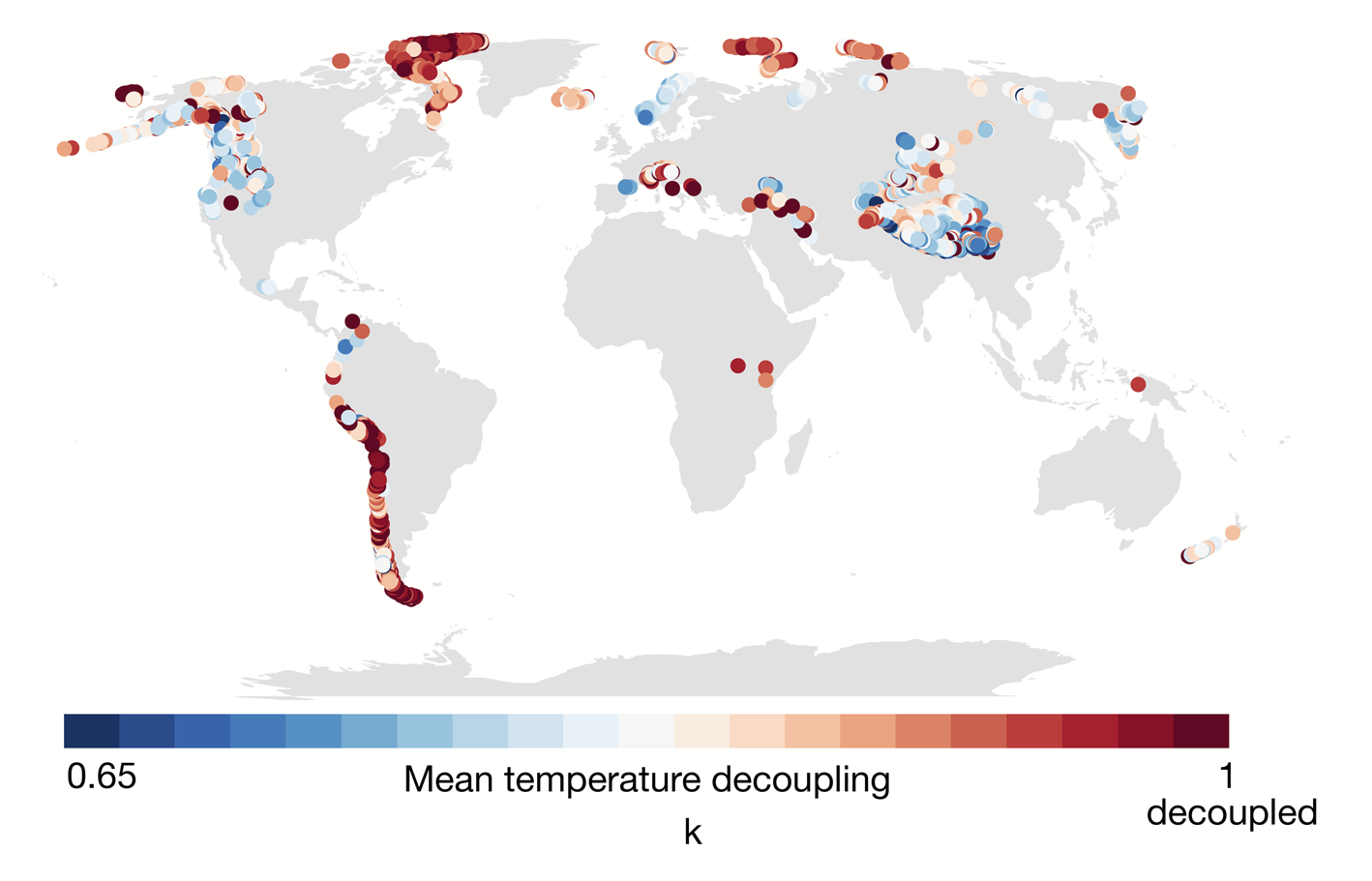
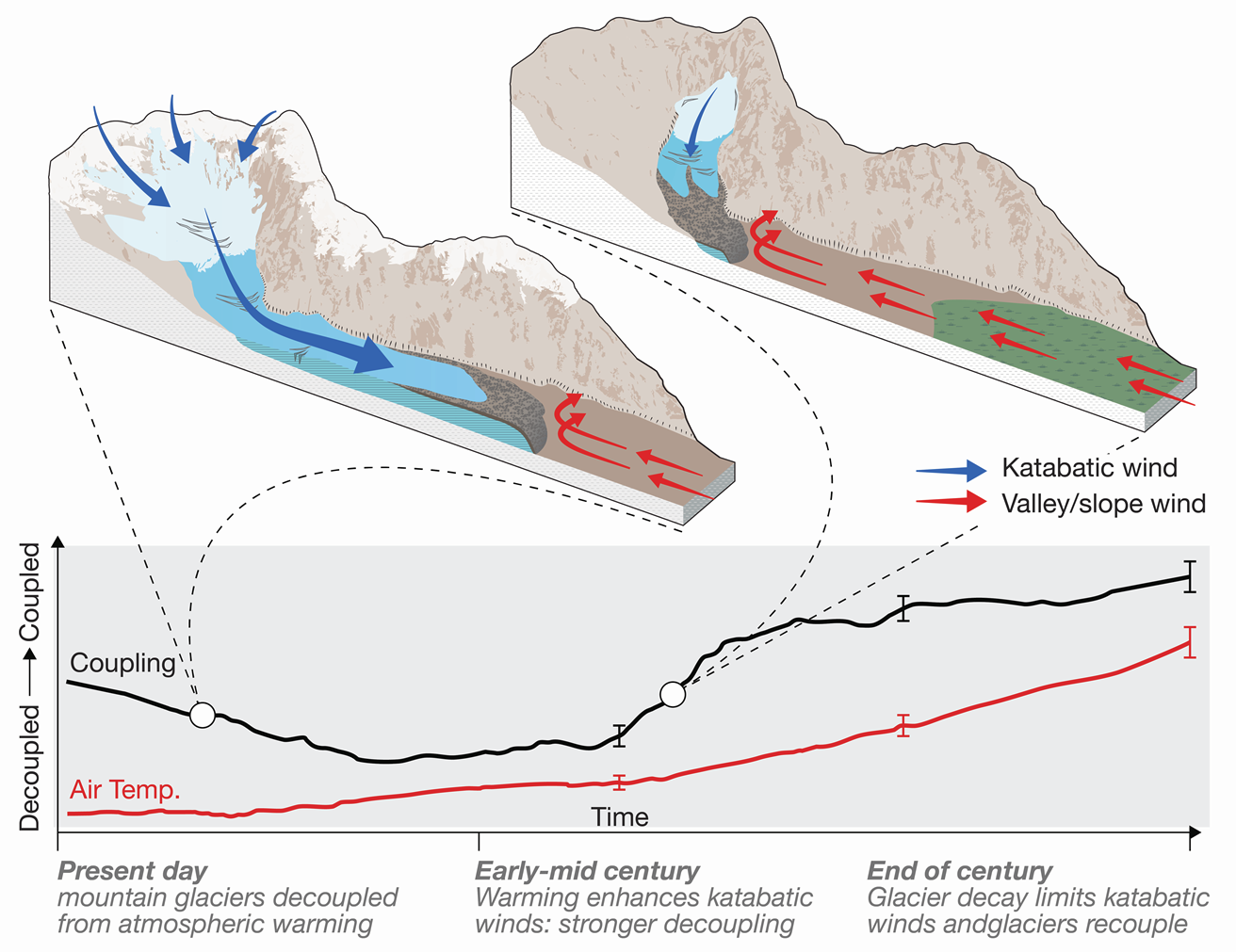
These are explained by the development over glacier surfaces of so-called katabatic winds, gravitational flows of warm air that has got in contact with cold glacier surfaces, has cooled and become denser and flows downwards. We conducted both experiments on glaciers and numerical modelling and published a number of papers on single glaciers and regions; in 2023 we achieved a major breakthrough by using these theories to explain the cooling observed in the Himalaya at high elevations (Salerno et al., 2023, Nature Geoscience, with Pellicciotti as last author). Finally in 2025 this line of research culminated in a major achievement led by postdoc Thomas Shaw, who determined the cooling due to katabatic winds and decoupling from the underlying atmospheric signal for every glacier on the globe (Figure 1 top below) and the future trajectories of recoupling of glaciers to the atmospheric warming trend (Figure 1 bottom below) (Shaw, Miles, McCarthy, Buri, Guyennon, Salerno, Carturan, Brock and Pellicciotti (2025). Mountain glaciers recouple to atmospheric warming over the twenty-first century. Nature Climate Change. https://doi.org/10.1038/s41558-025-02449-0).
This was a major breakthrough that pointed to a key non-linearity in glacier response to climate, not considered in current models of glacier changes projections. It is one of the tipping points and critical thresholds we are studying in the major “MountAInWater” project just funded by Schmidt Sciences, and we very much look forward to tackle this frontier research over the next years.