Catalysis and Synthetic Methodology
Chemistry

1 Career
- Since 2023 Assistant Professor, Institute of Science and Technology Austria (ISTA)
- 2018 – 2023 Group Leader, Max Planck Institute of Colloids and Interfaces (MPICI), Potsdam, Germany
- 2023 Guest Professor, University of Innsbruck, Austria
- 2022 Visiting Associate, California Institute of Technology (Caltech), Pasadena, CA, USA
- 2020 – 2022 Lecturer, University of Potsdam, Germany
- 2016 – 2017 Postdoc, Max Planck Institute of Colloids and Interfaces (MPICI), Potsdam, Germany
- 2015 PhD, University of Graz, Austria
1.1 Selected Distinctions
- 2025 Dr. Otto Röhm Memorial Foundation Award
- Since 2025 Member of the International Editorial Advisory Board of ChemPhotoChem and the European Journal of Organic Chemistry (Chemistry Europe, Wiley-VCH)
- Since 2025 Member of the Board & Treasurer, European Chemical Society – Division of Organic Chemistry
- 2025 Co-chair and organizer of the Photoexciting Molecules conference, ISTA, September 17-19, 2025
- Since 2015 >40 invited lectures in North America, South America, Europe, and Asia
1.2 Selected Grants
- 2024 – 2025 ACS Green Chemistry Institute Pharmaceutical Roundtable Ignition grant, Iron catalyzed carbon–carbon cross-couplings triggered by visible-light, Awarded: € 40,000.
- 2024 – 2028 FWF Principal Investigator Project, Photoactive ligands for transformative nickel catalysis, Awarded: € 481,000.
- 2022 – 2025 Boehringer Ingelheim Foundation Plus 3 perspectives programme, Overcoming Limitations in Photocatalysis, Awarded: € 839,000 (terminated in 2023 – grant was not movable from Germany to Austria).
1.3 Tech Transfer (Patents, Spin-Offs)
- K. Gilmore, P. H. Seeberger, S. Chatterjee, B. Pieber, Modular Continuous Flow Device. WO 2017/148874.
- P. D. Cox, C. O. Kappe, B. Pieber, Selective reduction of morphinan alkaloids. US 2017/0137432.
1.4 Selected Publications
- A. Petrik, A. R. Bena, H. Baunis, R. M. Kelch, T. P. Yoon, B. Pieber, Facile access to N-substituted pyridyl ligands. Advanced Synthesis & Catalysis 2026, in press, DOI: 10.1002/adsc.70417.
- A. Bena, B. Pieber, Advances in Niᴵ/Niᴵᴵᴵ‐catalyzed C(sp²)–heteroatom cross‐couplings. ACS Catalysis 2026, 16, 866-881.
- L. Anghileri, H. Baunis, A. R. Bena, C. Giannoudis, J. H. Burke, S. Reischauer, C. Merschjann, R. F. Wallik, T. Al Said, C. E. Adams, G. Simionato, S. Kovalenko, L. Dell’Amico, R. Van der Veen, B. Pieber, Evidence for a unifying NiI/NiIII paradigm in light-mediated cross-coupling catalysis. Journal of the American Chemical Society 2025, 147, 13158-13168.
- C. Cavedon, S. Gisbertz, S. Reischauer, S. Vogl, E. Sperlich, J. H. Burke, R. F. Wallick, S. Schrottke, W.-Hs. Hsu, L. Anghileri, Y. Pfeifer, N. Richter, C. Teutloff, H. Müller-Werkmeister, D. Cambié, P. H. Seeberger, J. Vura-Weis, R. M. van der Veen, A. Thomas, B. Pieber, Intraligand Charge Transfer Enables Visible-Light-Mediated Nickel-Catalyzed Cross-Coupling Reactions. Angewandte Chemie International Edition 2022, 61, e202211433.
- S. Gisbertz, S. Reischauer, B. Pieber, Overcoming Limitations in Dual Photoredox/Nickel-catalysed C–N Cross-Couplings due to Catalyst Deactivation. Nature Catalysis 2020, 3, 611-620.
2 Group Members
- Haralds Baunis, PhD Student since 2022
- Mirea Belil-Catalina, PhD Student since 2025
- Aleksander Bena, PhD Student since 2022
- Christos Giannoudis, PhD Student since 2022
- Florian Ortis, PhD Student since 2024
- Liane Perktold, PhD Student since 2025
- Adam Petrik, PhD Student since 2024
- Callum E. Adams, Postdoc since 2023
- Trisha Banik, Postdoc since 2024
3 Research
Our group focuses on developing innovative catalytic strategies for sustainable organic synthesis, with a particular emphasis on visible-light-mediated processes. By combining mechanistic insight with catalyst design, we create new methodologies that enable challenging chemical transformations. A central research direction is the development of photoactive ligands for nickel catalysis, which allow precise control over reactive intermediates and enable efficient C–heteroatom and C–C bond formation under mild conditions. We also explore heterogeneous photocatalysts, such as carbon-based materials, to provide recyclable and scalable alternatives to traditional systems. In addition, we design new reactions that harness radical intermediates, expanding the synthetic toolbox with transformations not accessible through conventional two-electron pathways. Overall, our work aims to deliver more sustainable, efficient, and versatile approaches for the synthesis of complex molecules relevant to pharmaceuticals and materials science.
3.1 Current Scientific Projects/Directions
- Ligand design for light-mediated first-row transition metal catalysis
- Understanding and controlling the reactivity of NiI species
- Synchronized nucleophile–electrophile generation using photochemical approaches
3.2 Research in Focus
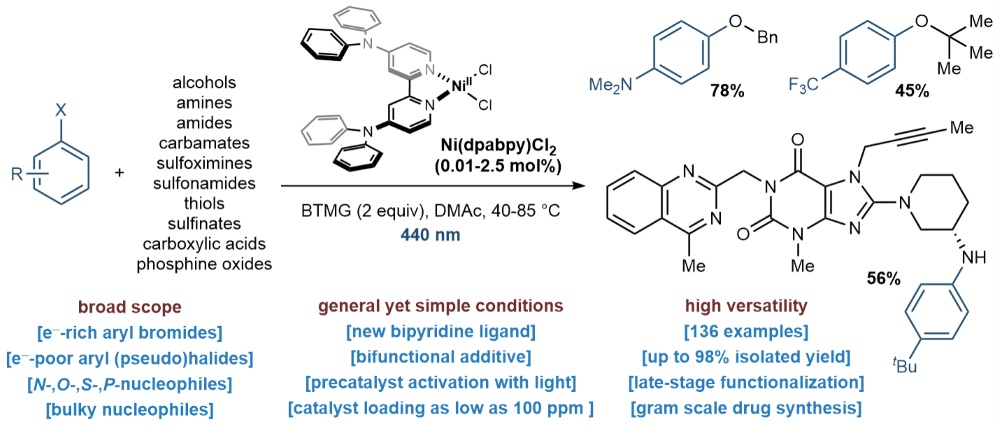
We have recently developed a broadly applicable strategy to overcome key limitations in Niᴵ/Niᴵᴵᴵ-catalyzed C(sp²)–heteroatom cross-couplings through mechanistically guided ligand and additive design. While nickel catalysis offers an attractive alternative to palladium due to favorable reductive elimination, its practical use has been restricted by low oxidative addition reactivity, limited substrate scope, catalyst deactivation, and the need for high catalyst loadings.
To address these challenges, we designed a new bipyridine ligand (dpabpy) that balances high reactivity of the Niᴵ metalloradical with stabilization via a ligand-centered radical reservoir. In combination with a non-nucleophilic base (BTMG), this system enables the direct, visible-light-mediated generation of active Niᴵ species from a bench-stable Niᴵᴵ precatalyst, eliminating the need for an exogenous photoredox catalyst. Our approach provides a general and operationally simple platform for cross-coupling a wide range of aryl halides, including challenging electron-rich substrates, with a diverse set of nucleophiles (N, O, S, and P-based). Notably, we demonstrate for the first time that Niᴵ/Niᴵᴵᴵ catalysis can efficiently engage sterically hindered nucleophiles such as tertiary alcohols and α,α,α-trisubstituted amines. Furthermore, the method operates at exceptionally low nickel loadings (down to 100 ppm), significantly improving efficiency and scalability. We showcase the practical utility of this catalytic platform through late-stage functionalization of complex molecules and gram-scale synthesis of pharmaceutical compounds, underscoring its potential for applications in medicinal chemistry and process-scale synthesis. Overall, our work establishes a general design principle for controlling radical nickel intermediates and represents a significant step toward widely applicable, low-loading nickel catalysis for C–heteroatom bond formation.
This work is currently under revision (Nature Catalysis) and was deposited as a preprint: A. R. Bena, T. Banik, C. Giannoudis, F. Ortis, D. Bím, H. Baunis, G. H. Palissery, B. Pieber, Ligand design overcomes bottlenecks in NiI-catalyzed C(sp²)–heteroatom couplings. ChemRxiv 2025, DOI: 10.26434/chemrxiv-2025-1czpp.