
Computational Soft & Living Matter
Physics

Andela Saric
Professor
1 Career
- Since 2023 Professor, Institute of Science and Technology Austria (ISTA)
- 2022 – 2023 Assistant Professor, Institute of Science and Technology Austria (ISTA)
- 2019 – 2023 Associate Professor (tenured), University College London, UK
- 2016 – 2019 Group Leader and Lecturer, University College London, UK
- 2014 – 2017 Emmanuel College Research Fellow, University of Cambridge, UK
- 2013 – 2016 Postdoc, University of Cambridge, UK
- 2013 PhD, Columbia University, NYC, USA
1.1 Selected Distinctions
- 2026 EMBO Member
- 2021 – 2026 EMBO Young Investigator
- 2026 Simons Foundation Distinguished Visiting Professorship, NYU, USA
- 2022 – 2026 Vallee Scholarship
- 2019 – 2025 ERC Starting Grant
- 2016 – 2022 Royal Society University Research Fellowship
1.2 Selected Grants
- 2027 – 2032 Austrian Science Fund- Emerging Fields, Visualizing the Transmission of Genetic Information in the Germline, Coordinator: A. Pauli (IMP). Awarded overall: € 5,141,507; awarded to RG: € 857,166.
- 2024 – 2027 Allen Foundation-Distinguished Investigator Award, Chemically active membranes in evolution of cell shape, Coordinator: A. Šarić (ISTA). Awarded overall: $ 1,500,000; awarded to RG: $ 500,000.
- 2024 – 2032 Wellcome Trust-Discovery Award, How do you build a wall? Mechanistic principles of bacterial division septum building, Coordinator: H. Séamus (Warwick University). Awarded overall: £ 3,506,268; awarded to RG: £ 832,298.
1.3 Tech Transfer (Patents, Spin-Offs)
N/A
1.4 Selected Publications
- R. Barrientos, B. Meadowcroft, B. Sanchez Sanchez, B. Stramer, E. Paluch, G. Charras, S. Banerjee, A. Šarić, and Y. Mao, “Basement membrane turnover controls cell shape,” Cell, in press, 2026.
- C. Vanhille-Campos, K. Whitley, P. Radler, M. Loose, S. Holden, and A. Šarić, “Self-organization of mortal filaments and its role in bacterial division ring formation,” Nature Physics, vol. 20, pp. 1670–1678, 2024. https://doi.org/10.1038/s41567-024-02597-8.
- C. Bussi, A. Mangiarotti, C. Vanhille-Campos, et al., A. Šarić, V. Dimova, and M. Gutiérrez, “Stress granules plug and stabilise damaged endomembranes,” Nature, vol. 623, pp. 1062–1068, 2023. https://doi.org/10.1038/s41586-023-06726-w.
- S. Curk, J. Krausser, et al., T. P. J. Knowles, and A. Šarić, “Self-replication of Aβ42 fibrils occurs on distinct and rare fibril sites,” Proceedings of the National Academy of Sciences of the United States of America, vol. 121, no. 7, p. e2220075121, 2024. https://doi.org/10.1073/pnas.2220075121.
- L. Harker-Kirschneck, A. E. Hafner, et al., R. Henriques, B. Baum, and A. Šarić, “Physical mechanisms of ESCRT-III-driven cell division,” Proceedings of the National Academy of Sciences of the United States of America, vol. 119, p. e2107763119, 2022. https://doi.org/10.1073/pnas.2107763119.
2 Group Members
- Zahra Akbari, PhD Student since 2025
- Marija Krstic, PhD Student since 2024
- Juraj Majek, PhD Student since 2024
- Mau Rojas, PhD Student since 2023
- Michael Wassermair, PhD Student since 2025
- Felix Wodaczek, PhD Student since 2024
- Camilla Beneduce, Postdoc since 2026
- Yongick Cho, Postdoc since 2025
- Tobias Dwyer, Postdoc since 2025
- Andraz Gnidovec, Postdoc since 2025
- Ferdinand Horvath, Postdoc since 2024
- Maitane Munoz-Basagoiti, Postdoc since 2023
- Fernanda Perez-Verdugo, Postdoc since 2025
3 Research
How do lifeless molecules create living organisms? How can such processes fail, resulting in diseases? At the intersection of soft matter physics, molecular cell biology, and physical chemistry, we study physical mechanisms behind non-equilibrium self-organization of biomolecules in healthy and diseased states.
Currently, the group is focused on investigating the physical principles of cellular reshaping, cell division, and cell symbiosis across the tree of life, driven by macromolecular self-organisation and the consumption of energy and matter. We develop computational models rooted in soft matter and statistical physics, which are powerful in traversing scales and investigating collective phenomena. The group closely collaborates with experimental colleagues on a range of systems, from synthetic and reconstituted systems, to living cells.
3.1 Current Scientific Projects/Directions
- Membrane fusion in sperm-egg fertilization
- Shapes of archaeal cells in symbiosis, in the context of eukaryogenesis and ecology
- Mesoscale self-organisation driven by molecular turnover
- Physical mechanisms of bacterial division
- Physical mechanisms behind cell reshaping in cell division and motility
3.2 Research in Focus
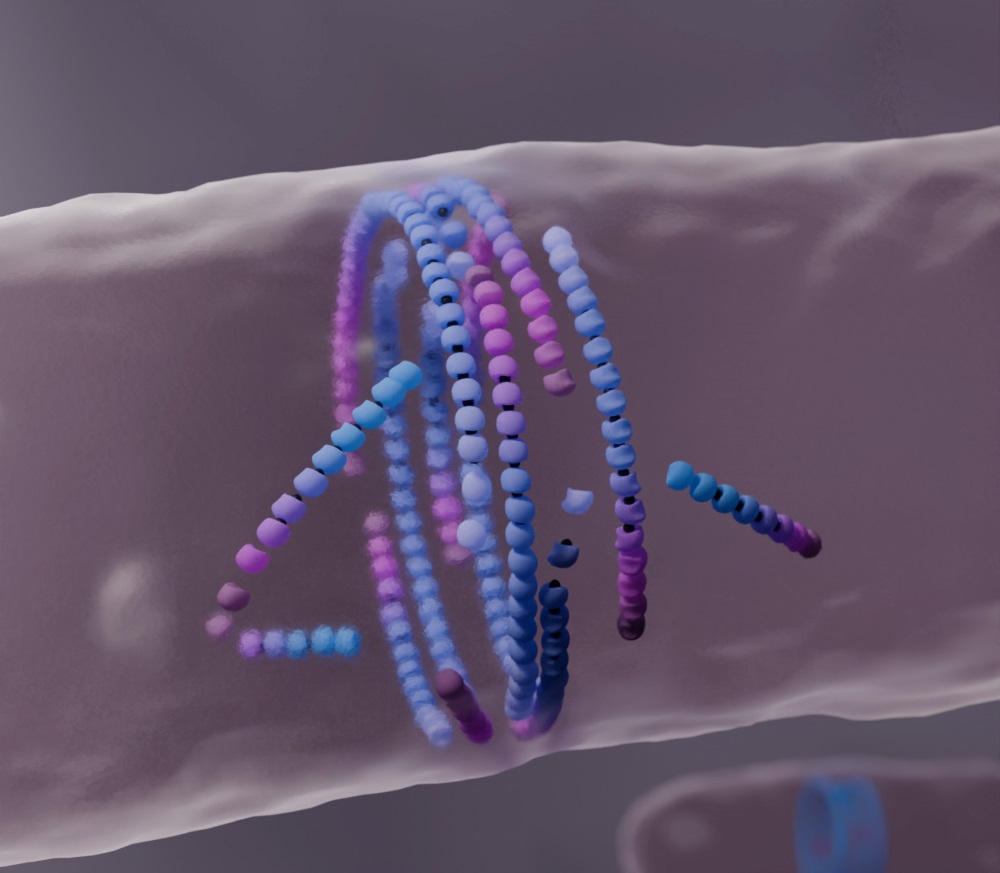
Biological structures are constantly being built, remodeled, and dismantled, yet they are remarkably good at organizing themselves into functional shapes. A striking example is the bacterial division ring, a structure that forms around the middle of a bacterium and helps it divide into two daughter cells. This ring is made of protein filaments that are continuously renewed: new building blocks are added at one end while old ones are removed from the other. How such a constantly changing system can reliably assemble into an ordered structure has remained unclear. In this work, we used computer simulations together with experimental observations to investigate this question. We discovered a simple self-organizing principle based on physical interactions: filaments that are poorly aligned run into one another, preventing their growth and causing them to disappear, while aligned filaments survive and grow. In effect, the system improves its organization by selectively removing mistakes, allowing a highly ordered division ring to emerge without central control. This mechanism helps explain how bacteria reliably organize the machinery needed for cell division despite the constant turnover of their components. More broadly, our findings reveal a new way in which living systems can create order from continual renewal and may inspire the design of self-organizing synthetic materials. This work was published in Nature Physics: Christian Vanhille Campos et al., Self-organisation of mortal filaments and its role in bacterial division ring formation, Nature Physics (2024).

