
Quantum Dynamics and Condensed Matter Theory
Physics

Maksym Serbyn
Professor
1 Career
- Since 2022 Professor, Institute of Science and Technology Austria (ISTA)
- 2017 – 2022 Assistant Professor, Institute of Science and Technology Austria (ISTA)
- 2014 – 2017 Gordon and Betty Moore Postdoctoral Fellow, University of California, Berkeley, USA
- 2014 PhD, Massachusetts Institute of Technology, Cambridge, USA
1.1 Selected Distinctions
- 2025 ERC Consolidator Grant
- 2023 Lower Austrian Science Award
- 2019 ERC Starting Grant
- 2019 Ludwig Boltzmann Prize
- 2013 Andrew Locker III Memorial Fund Award, Massachusetts Institute of Technology
- 2009 – 2010 Praecis Presidential Graduate Fellowship, Massachusetts Institute of Technology
1.2 Selected Grants
- 2025 ERC Consolidator Grant
- 2019 ERC Starting Grant
1.3 Tech Transfer (Patents, Spin-Offs)
N/A
1.4 Selected Publications
- D. Bluvstein, A. Omran, H. Levine, A. Keesling, G. Semeghini, S. Ebadi, T. T. Wang, A. A. Michailidis, N. Maskara, W. W. Ho, S. Choi, M. Serbyn, M. Greiner, V. Vuletić, and M. D. Lukin, “Controlling many-body dynamics with driven quantum scars in rydberg atom arrays,” Science, vol. 371, no. 6536, pp. 1355–1359, 2021. DOI: 10.1126/science.abg2530. [Online]. Available: https://doi.org/10.1126/science.abg2530.
- N. Maskara, A. A. Michailidis, W. W. Ho, D. Bluvstein, S. Choi, M. D. Lukin, and M. Serbyn, “Discrete time-crystalline order enabled by quantum many-body scars: Entanglement steering via periodic driving,” Physical Review Letters, vol. 127, p. 090 602, 2021. DOI: 10.1103/PhysRevLett.127.090602. [Online]. Available: https://doi.org/10.1103/PhysRevLett.127.090602.
- H. Zhou, T. Xie, A. Ghazaryan, T. Holder, J. R. Ehrets, E. M. Spanton, T. Taniguchi, K. Watanabe, E. Berg, M. Serbyn, and A. F. Young, “Half and quarter metals in rhombohedral trilayer graphene,” Nature, vol. 598, pp. 429–433, 2021. DOI: 10.1038/s41586-021-03938-w. [Online]. Available: https://doi.org/10.1038/s41586-021-03938-w.
- A. Ghazaryan, T. Holder, E. Berg, and M. Serbyn, “Multilayer graphenes as a platform for interaction-driven physics and topological superconductivity,” Physical Review B, vol. 107, p. 104 502, 2023. DOI: 10.1103/PhysRevB.107.104502. [Online]. Available: https://doi.org/10.1103/PhysRevB.107.104502.
- M. Ljubotina, E. Petrova, N. Schuch, and M. Serbyn, “Tangent space generators of matrix product states and exact floquet quantum scars,” PRX Quantum, vol. 5, p. 040 311, 2024. DOI: 10.1103/PRXQuantum.5.040311. [Online]. Available: https://doi.org/10.1103/PRXQuantum.5.040311.
2 Group Members
- Serafim Babkin, PhD Student
- Aron Kerschbaumer, PhD Student
- Dmytro Kolisnyk, PhD Student
- Elena Petrova, PhD Student
- Jean-Yves Desaules, Postdoc
- Eloi Nicolau Jiménez, Postdoc
- Lucia Vigliotti, Postdoc
- Yupeng Wang, Postdoc
3 Research
How do isolated quantum systems behave when prepared in a highly non-equilibrium state? How can such quantum systems avoid the ubiquitous relaxation to a thermal equilibrium? How can we gain novel insights into properties of quantum matter using modern nonequilibrium probes? These and other open questions in the field of quantum non-equilibrium matter are the focus of the Serbyn group. The majority of isolated quantum systems thermalize – i.e. they reach thermal equilibrium when starting from non-equilibrium states. The first research direction of the Serbyn group is to understand mechanisms of thermalization breakdown. Many-body localized systems present one generic example of thermalization breakdown due to the presence of strong disorder. The Serbyn group is studying properties of many-body localized phase and phase transition into thermalizing phase. Kinetically constrained models present another class of systems with some signatures of thermalization breakdown. The Serbyn group is actively working on non-equilibrium properties of quantum models with constrained dynamics. A second area of interest to the Serbyn group is related to non-equilibrium probes in condensed matter systems and superconductivity.
3.1 Current Scientific Projects/Directions
- Weak ergodicity breaking and quantum chaos
- Emergent quasi-solitons in highly excited states of quantum many-body systems
- Learning and characterizing quantum many-body states
- Non-equilibrium Josephson junction chains
- Hybrid semiconductor-superconductor quantum devices
3.2 Research in Focus
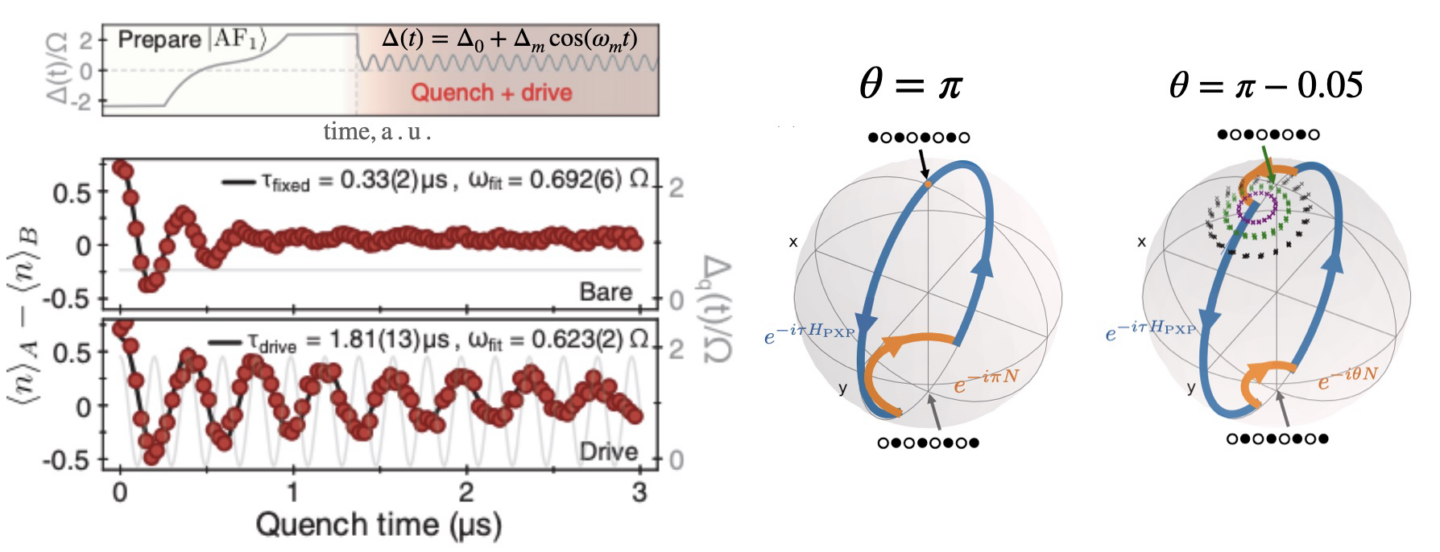
Controlling non-equilibrium quantum dynamics in many-body systems is a central challenge in modern quantum science. A key obstacle is that interactions typically drive systems toward thermalization, causing coherent quantum information to rapidly spread and become inaccessible throughout Hilbert space. The collaboration of Serbyn group with Lukin group from Harvard university experimentally demonstrated existence of quantum many-body scars (special non-thermal eigenstates that give rise to persistent coherent revivals) in a broad range of geometries and also with periodic driving.
In this collaboration, Serbyn group contributed to demonstrating existence of scar-induced coherent revivals in Rydberg atom arrays and understanding of their properties. The experiments, performed on programmable Rydberg atom quantum simulators in one and two spatial dimensions, revealed that scars are robust across a wide parameter regime and leave characteristic signatures in Hilbert space dynamics. Surprisingly, experiment revealed stabilization of quantum scars under periodic driving. On the theoretical side, we explained the stabilization and emergent subharmonic response by the discrete time crysal behavior in a prethermal regime. Crucially, unlike conventional discrete time crystals, the response exists selectively for scar-associated initial states, demonstrating a novel route to steering entanglement dynamics in interacting quantum systems.
These results establish quantum many-body scars as a practical resource for protecting non-equilibrium quantum order against thermalization. The experimental results were published in Ref. [1], and the theoretical analysis in Ref. [2].

