
Symmetry Probes of Quantum Matter
Physics

Veronika Sunko
Assistant Professor
1 Career
- Since 2025 Assistant Professor, Institute of Science and Technology Austria (ISTA)
- 2024 – 2025 Postdoctoral Scholar, UC Berkeley, USA (Orenstein Lab)
- 2021 – 2024 Miller Postdoctoral Fellow, UC Berkeley, USA (Orenstein Lab)
- 2020 – 2024 Minerva Fast Track Fellow, Max Planck Institute for Chemical Physics of Solids, Dresden, Germany
- 2015 – 2019 PhD, University of St Andrews, UK and Max Planck Institute for Chemical Physics of Solids, Germany
- 2009 – 2014 MSc, University of Zagreb, Croatia
1.1 Selected Distinctions
- 2021 – 2024 Miller Research Fellowship, UC Berkeley
- 2020 – 2024 Minerva Fast Track Fellowship, Max Planck Society
- 2020 Otto Hahn Medal, Max Planck Society
- 2020 Richard L. Greene Dissertation Award in Experimental Condensed Matter or Materials Physics, American Physical Society
1.2 Selected Grants
- 2024 – 2028 DFG Collaborative Research Centre TRR 288 ELASTO-Q-MAT, Project A10 “Stress-strain measurements and development of a thermodynamic elasto-scope”. Co-PI with H. Noad and A. P. Mackenzie (MPI-CPfS Dresden).
1.3 Tech Transfer (Patents, Spin-Offs)
N/A
1.4 Selected Publications
- E. Donoway et al., “Multimodal approach reveals the symmetry-breaking pathway to the broken helix in EuIn2As2,” Physical Review X, vol. 14, no. 3, p. 031 013, 2024, issn: 2160-3308. DOI: 10.1103/PhysRevX.14.031013. [Online]. Available: https://dx.doi.org/10.1103/PhysRevX.14.031013.
- F. Sun et al., “The Lorenz ratio as a guide to scattering contributions to Planckian transport,” Proceedings of the National Academy of Sciences, vol. 121, no. 35, e2318159121, 2024, issn: 1091-6490. DOI: 10.1073/pnas.2318159121. [Online]. Available: https://dx.doi.org/10.1073/pnas.2318159121.
- V. Sunko et al., “Spin-carrier coupling induced ferromagnetism and giant resistivity peak in EuCd2P2,” Physical Review B, vol. 107, no. 14, p. 144 404, 2023, issn: 2469-9969. DOI: 10.1103/PhysRevB.107.144404. [Online]. Available: https://dx.doi.org/10.1103/PhysRevB.107.144404.
- V. Sunko et al., “Controlled introduction of defects to delafossite metals by electron irradiation,” Physical Review X, vol. 10, no. 2, p. 021 018, 2020, issn: 2160-3308. DOI: 10.1103/PhysRevX.10.021018. [Online]. Available: https://dx.doi.org/10.1103/PhysRevX.10.021018.
- V. Sunko et al., “Probing spin correlations using angle-resolved photoemission in a coupled metallic/Mott insulator system,” Science Advances, vol. 6, no. 6, eaaz0611, 2020, issn: 2375-2548. DOI: 10.1126/sciadv.aaz0611. [Online]. Available: https://dx.doi.org/10.1126/sciadv.aaz0611.
2 Group Members
- Monalisa Garai, Research Technician since 2025
3 Research
Quantum materials host phases that emerge from the collective behaviour of electrons. Their hallmark is the spontaneous breaking of symmetries, underlying phenomena from magnetism and ferro-electricity to unconventional superconductivity and topological order. Identifying which symmetries are broken, and how, is central to understanding what a quantum phase is and what it can do.
In the Symmetry Probes of Quantum Matter group, we develop experimental methods directly sensitive to broken symmetries, and use them to discover, characterise and manipulate novel phases of matter. While symmetry is a universal organising principle, its observable manifestations are material-specific and span very different energy scales. We therefore combine complementary tools, in particular optical spectroscopy, angle-resolved photoemission spectroscopy (ARPES) and electrical transport, with theoretical modelling that ties the measurements into a coherent microscopic picture of each material.
Our current focus is on optical probes of unconventional magnetism and chirality, including linear magneto-birefringence and magneto-electric birefringence, which access symmetries hard to detect otherwise. We apply these techniques to bulk crystals and to atomically thin flakes and heterostructures, where many standard probes fail. Our long-term goal is to establish a versatile, symmetry-sensitive platform for quantum materials, and to use it to identify the microscopic mechanisms behind emergent phases.
3.1 Current Scientific Projects/Directions
- Optical probes of unconventional magnetism, including altermagnets
- Symmetry-sensitive optics of two-dimensional materials and heterostructures
- Symmetry-resolved electronic-structure studies via ARPES and transport
3.2 Research in Focus
Determining whether a material breaks time-reversal symmetry (TRS) is a central question in the study of magnetic and topological quantum phases. Optical methods are well suited to address it: they are non-contact, work across a wide range of temperatures and magnetic fields, and remain effective on samples ranging from bulk single crystals to atomically thin flakes and heterostructures, where most other probes fail. The standard optical probe of TRS breaking, the polar magneto-optical Kerr effect (MOKE), is sensitive to many magnetic phases but vanishes in others where TRS breaking is nevertheless present. A complementary optical probe, applicable in such cases, is therefore needed.
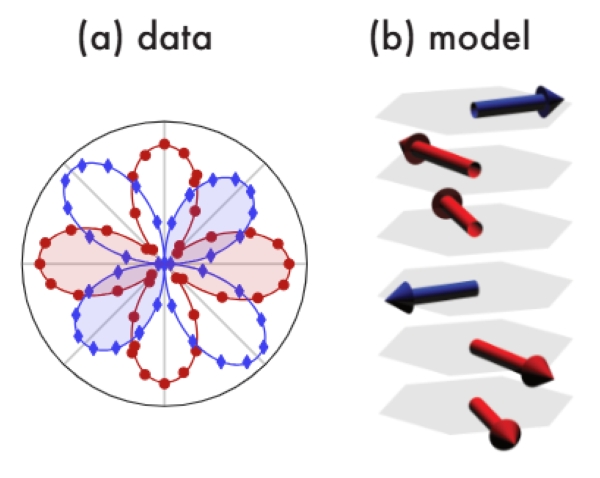
We developed linear magneto-birefringence (LMB) – the change in optical birefringence linear in an applied magnetic field – as such a probe. Because it is complementary to MOKE, LMB allows characterisation of materials whose order is otherwise difficult to identify, including the determination of magnetic transition temperatures, the disentangling of competing magnetic states, and the response to external tuning parameters.
Our first application of LMB, to the Eu-based magnet EuCd2P2, showed that the onset of magnetism occurs at a temperature substantially higher than the previously reported bulk ordering temperature, clarifying the mechanism behind the giant resistivity peak observed in this material [V. Sunko et al., Phys. Rev. B 107, 144404 (2023)]. Building on this, we used LMB together with strain tuning, scattering, and theory to settle a controversy regarding the magnetic and topological character of EuIn2As2: we identified its ground state as a “broken helix” (Fig. 1) and showed how its symmetries can be classified and selectively restored, reconciling previously conflicting experimental reports [E. Donoway et al., Phys. Rev. X 14, 031013 (2024)].
In parallel, we developed a microscopic understanding of LMB. Working with theorists, we showed that LMB is well suited to detect altermagnets, a recently identified class of compensated magnets with momentum-dependent spin splitting and no net moment [M. Vila, V. Sunko, J. E. Moore, Phys. Rev. B 112, L020401 (2025)]. Together, these results establish LMB as a useful probe of TRS breaking across a range of magnetic phases, and provide the methodological basis for the symmetry-sensitive optical platform we are building at ISTA.

