August 12, 2026
Black Hole Star: Mirage or Miracle?
ISTA scientists may solve riddle of supermassive black holes in the early Universe
Little red dots have puzzled astronomers since their discovery in JWST data from the Universe’s deep past. Their ‘powering engines’ might resemble a newly discovered phenomenon dubbed a “black hole star”—an early, rapidly growing black hole wrapped in dense gas. This object, described in a study published today in Nature by researchers at the Institute of Science and Technology Austria (ISTA) and international collaborators, may help explain how billion-solar-mass black holes formed so soon after the Big Bang.
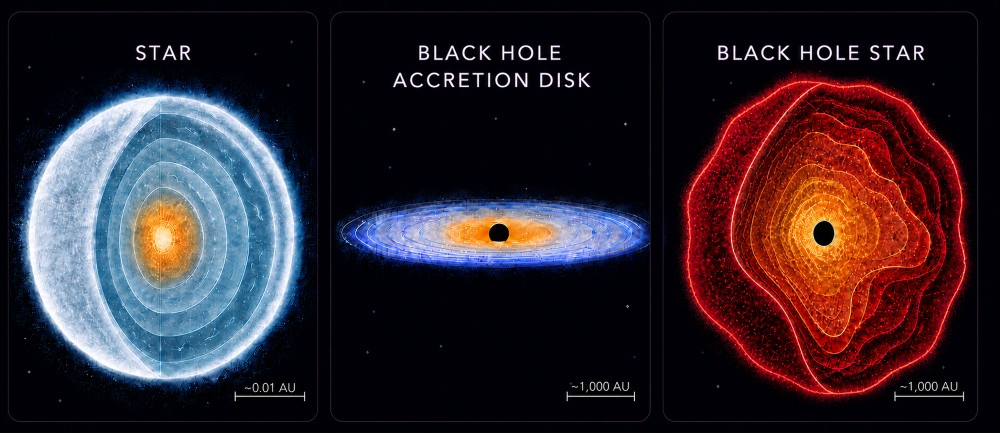
Black holes with masses millions to billions of times that of the Sun lurk at the centers of massive galaxies. Beyond being cosmic points of no return, they also play a crucial role in determining the fate of galaxies, influencing their growth, evolution, and appearance. When they are actively accreting material, some of these cosmic Leviathans turn into extraordinarily bright quasars. But their origins remain difficult to explain.
“Until now, we have known very little about how these supermassive black holes formed. In addition, some quasars found in the early Universe seemed far too massive to exist, which led astronomers to call them ‘problematic quasars,’” says Jorryt Matthee, assistant professor at the Institute of Science and Technology Austria (ISTA).
Matthee worked with first author Rohan Naidu, assistant professor at the University of Hawai’i’s Institute for Astronomy, as part of the “Mirage or Miracle” survey using the James Webb Space Telescope (JWST). The study was conducted while Naidu was a NASA Hubble Fellow and Pappalardo Fellow at MIT’s Kavli Institute for Astrophysics and Space Research.
By spotting the earliest “black hole star” to date at the dawn of the Universe, the team may ultimately help solve the mystery of supermassive black holes in the deep past. The key: this newly identified object may resemble the powering engines behind hundreds of mysterious “little red dots” that the team found in JWST datasets in 2024—the ‘baby quasars,’ as Matthee described them at the time after coining the phrase “little red dots”.
Solving a puzzle at cosmic dawn
Explaining how billion-solar-mass quasars formed when the Universe was so young has challenged scientists for decades. “Astronomers have never lacked imagination: since the discovery of quasars, there has been no dearth of theories to explain how these black holes grew so massive so fast,” says Naidu. “Something spectacular must have happened in the early Universe. Now with JWST, we can directly observe this era and see for ourselves which scenarios actually occur.”
Now, as part of the “Mirage or Miracle” survey, the international team led by Naidu and Matthee has discovered a unique object at cosmic dawn that offers new clues to the formation of supermassive black holes. If the early Universe is ‘cosmic dawn,’ today would be closer to cosmic afternoon or evening.
“The Mirage or Miracle survey was designed specifically to target sources considered ‘risky,’ meaning they could either be amazing discoveries or just interlopers, such as some cold nearby stars that look like distant galaxies. The survey also yielded the most distant galaxy ever confirmed, MoM-z14,” Matthee explains.
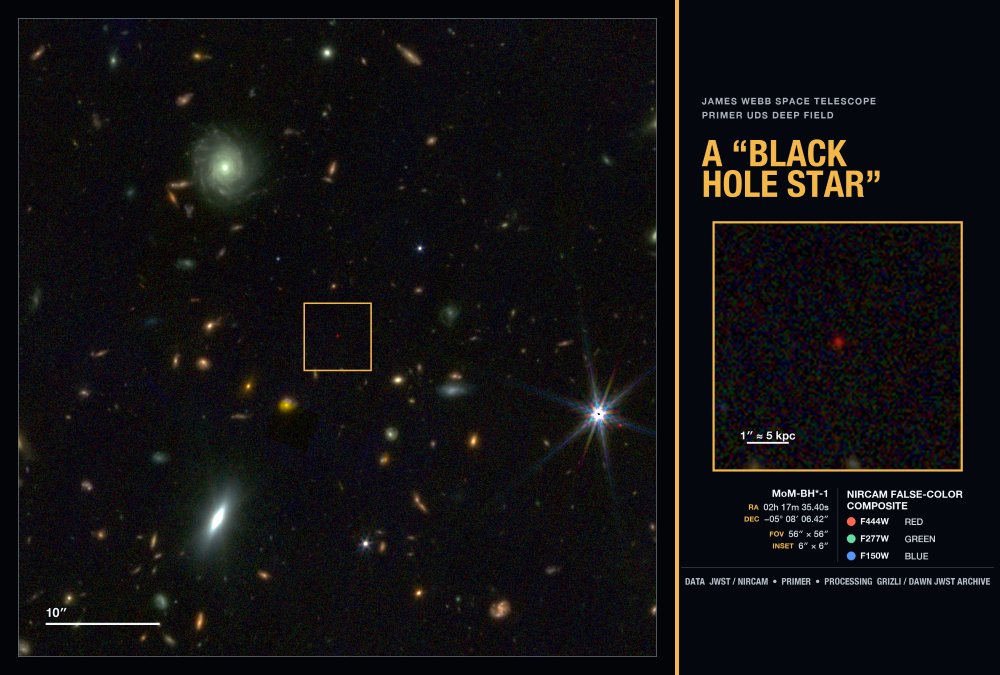
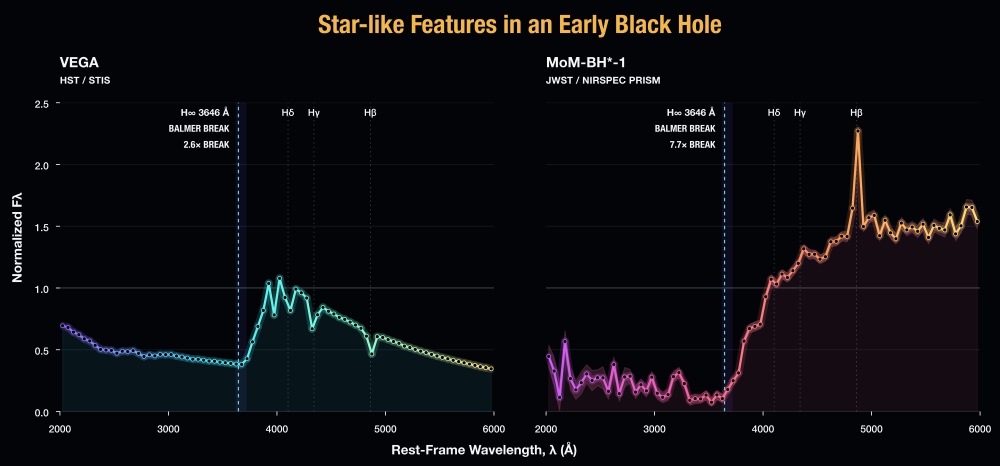
As for the object discovered in this study, the light now reaching us was emitted 13 billion years ago, only 660 million years after the Big Bang. “The spectrum we detected is our best evidence of a cloak of gas feeding an early-forming black hole,” explains Naidu. “Because of its spectrum and with a nod to the survey’s name, we dubbed the object ‘MoM-BH*-1.’”
The central engines of baby quasars?
In addition to the characteristic features of supermassive black holes, MoM-BH*-1 exhibits properties normally associated with stars. These include a spectral “jump” called the Balmer break. In the case of MoM-BH*-1, this spectral jump is exceptionally strong—stronger than those seen in star-forming galaxies, dust-free stellar populations, or the mysterious little red dots.
So far, the main challenge in understanding the little red dots has been to separate the emission from the central object from that of the galaxy in which it resides. MoM-BH*-1 resolves this issue for the first time by providing an unobstructed view of its core. Unlike little red dots, MoM-BH*-1 appears to account for nearly all the observed light, leaving little room for light from its host galaxy. Instead of being reddened by dust, as was previously thought of little red dots when they were first discovered, the black hole star is enshrouded by gas, which shifts its light emission toward the red end of the spectrum without blocking the view—similar to light scattering that turns sunsets red.
“We modeled MoM-BH*-1 as a miniature supermassive black hole in the earliest phases of its evolution, enshrouded by extremely dense, turbulent gas that forms a dust-free envelope around it,” says Naidu. “Theoretical models have already predicted that early black holes embedded in dense gas can grow rapidly through what is called super-Eddington accretion.”
Moreover, MoM-BH*-1 lies close to a brighter galaxy, and models suggest the two objects will eventually merge in about 100 million years. By superimposing spectra from both cosmic objects, the researchers found that the combined spectrum would closely resemble that of little red dots. “If embedded in similar host galaxies, black hole stars like MoM-BH*-1 might well serve as the central engines of baby quasars. Considering the black hole star as a template for the black hole component of little red dots helps clarify many of the uncertainties about them,” says Matthee.
Black hole stars at cosmic noon
On March 20, 2025, the discovery of MoM-BH*-1 was announced on the arXiv preprint server alongside another black hole star nicknamed “The Cliff”, a similar source at the “cosmic noon” epoch—the peak era of star formation and galaxy growth in the Universe, occurring roughly 2 to 3 billion years after the Big Bang. The simultaneous discovery of two such sources helped build community consensus that this was indeed a new class of objects.
Now that scientists have identified black hole stars, their spectra can serve as templates to guide new searches. In a recent ApJ Letters publication, ISTA postdoc Alberto Torralba, Matthee, and colleagues described another black hole star near cosmic noon. This observation further confirms that these curious objects can also be found at later cosmic times—though they are likely much less common there. Objects closer to Earth enable better measurements, such as with data from the European Southern Observatory’s Very Large Telescope, which Torralba and Matthee used in this paper.
The findings highlight the need to revisit existing models of the evolution of supermassive black holes and develop new ones that better match the observations. “These are incredibly exciting times with nearly a thousand papers and preprints on little red dots in the past two to three years,” Matthee says.
Together, these observations position black hole stars as the most robust explanation for little red dots, offering a path toward solving the fifty-year-old puzzle of the origin and evolution of supermassive black holes. “Far from a mirage, this might well be a cosmic miracle,” Matthee concludes.
Publication:
Rohan P. Naidu, Jorryt Matthee, et al. 2026. A Gas Enshrouded and Gas Reddened Black Hole at Cosmic Dawn. Nature. DOI: 10.1038/s41586-026-10846-4
Funding information:
This work is based on observations made with the NASA/ESA/CSA James Webb Space Telescope. The data were obtained from the Mikulski Archive for Space Telescopes at the Space Telescope Science Institute, which is operated by the Association of Universities for Research in Astronomy, Inc., under NASA contract NAS 5-03127 for JWST. These observations are associated with programs 5224 and 3543.
Some of the data presented in this study were retrieved from the Dawn JWST Archive (DJA). DJA is an initiative of the Cosmic Dawn Center (DAWN), which is funded by the Danish National Research Foundation under grant DNRF140.
This project was supported by funding from JWST programs GO-3516, GO-5224, and GO-1837. Support for this work was provided by NASA through the NASA Hubble Fellowship grant HST-HF2-51515.001-A awarded by the Space Telescope Science Institute, which is operated by the Association of Universities for Research in Astronomy, Incorporated, under NASA contract NAS5-26555. This work was also funded by the European Union (ERC AGENTS, 101076224; HEAVYMETAL, 101071865; RED CARDINAL, 101076080), the Swiss State Secretariat for Education, Research and Innovation (SERI) under contract number MB22.00072, as well as the Swiss National Science Foundation (SNSF) through project grant 200020 207349. This work was also supported by JSPS KAKENHI Grant Number 23H00131.
Authors further acknowledge support from the Gordon and Betty Moore Foundation and the John Templeton Foundation that fund the Black Hole Initiative (BHI) at Harvard University, as well as a UK Research & Innovation (UKRI) Future Leaders Fellowship [grant number MR/V023381/1].
Related publication:
Alberto Torralba, Jorryt Matthee, et al. 2026. A Black Hole Star at Cosmic Noon: Extreme Balmer Break, Photospheric Continuum, and Broad Absorption by Thick Winds in a Little Red Dot at z = 1.7. The Astrophysical Journal Letters. DOI: 10.3847/2041-8213/ae7bfd