August 18, 2026
Digital Dunes and Fortified (Sand) Castles
ISTA scientists tame unruly sand in graphics and simulations
Sand may seem simple, but for scientists it is one of nature’s trickiest materials to model. At the Institute of Science and Technology Austria (ISTA), researchers are reimagining sand one grain at a time, showing how tiny changes in shape can make sand flow, pile up, resist pressure—or even withstand attacks like a fortified (sand)castle. The findings were presented at a leading computer graphics conference and published in ACM Transactions on Graphics.

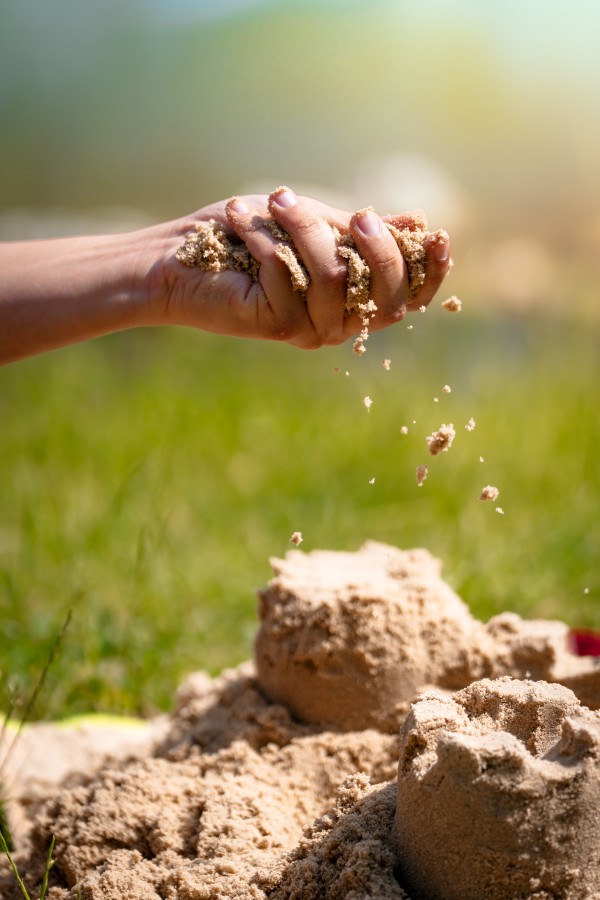
On a sunny summer’s day, children build sandcastles on the beach. But behind every castle and crumbling dune lies a surprisingly difficult scientific problem. In fact, the physics of sand is not yet fully understood—which also means that computer graphics lack effective ways to simulate it.
“It is hard to believe how little scientists know about sand,” says first author Yi-Lu Chen, a PhD student in the Wojtan group at the Institute of Science and Technology Austria (ISTA). “Do grains of sand behave like a pile of miniature rocks? Can they collectively behave in unexpected ways? We set out to investigate these questions.”
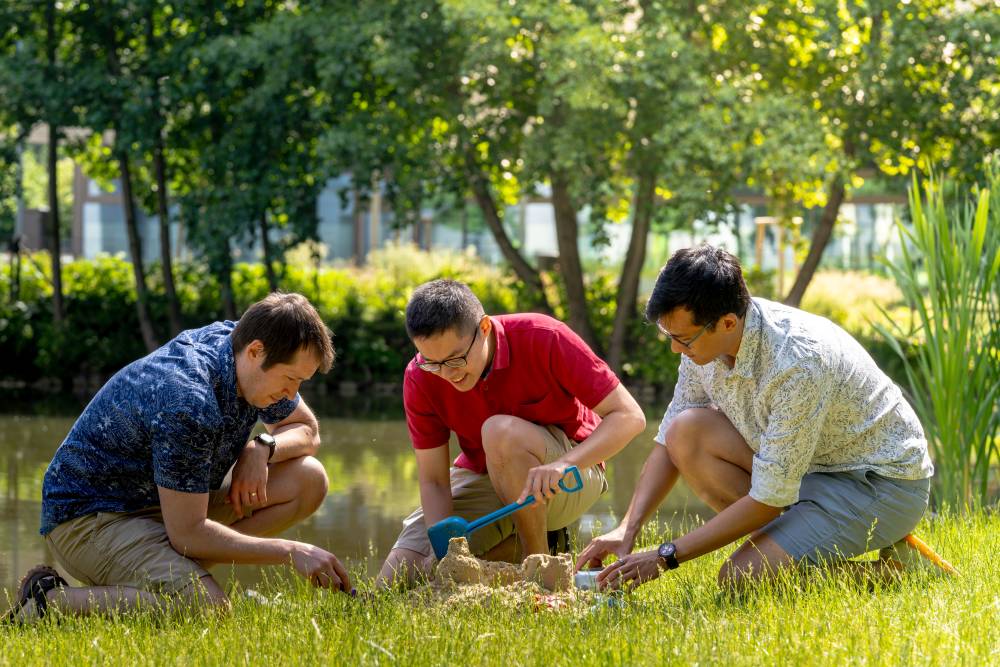
Beyond the playground, understanding sand can help researchers create more realistic digital landscapes, from avalanches and rockslides to the sweeping desert worlds of cinema. The challenge is that sand is made of countless grains, each with its own shape, size, position, and response to myriad physical forces.
“The difficulty in simulating sand lies in the exceptionally high number of variables in the problem, which makes calculating all possibilities very expensive,” says ISTA Professor Chris Wojtan. “Hence, we must find ways to simplify the computation without killing the problem.”
The shape of a grain
A gigantic eye opens under an enormous pile of gold coins. Before long, the dragon Smaug wakes from his deep sleep and chases Bilbo Baggins through the Treasure Hall, each of his movements generating waves in the never-ending sea of gold coins.
To produce this iconic scene from the 2013 movie “The Hobbit: The Desolation of Smaug,” the visual effects team quickly understood that simulating a billion gold coins was out of the question. For maximum realism, they had to film and digitally replicate the movements of 40,000 prop coins—exhausting the supply of gold paint across Australasia and forcing them to import more from Germany.
While this movie reference is reminiscent of sand behavior, simulating real sand might prove even more complex. To achieve an effective and inexpensive sand simulation without sacrificing realism, the ISTA team focused on one of the most important—and most complex—features of a grain: its shape.
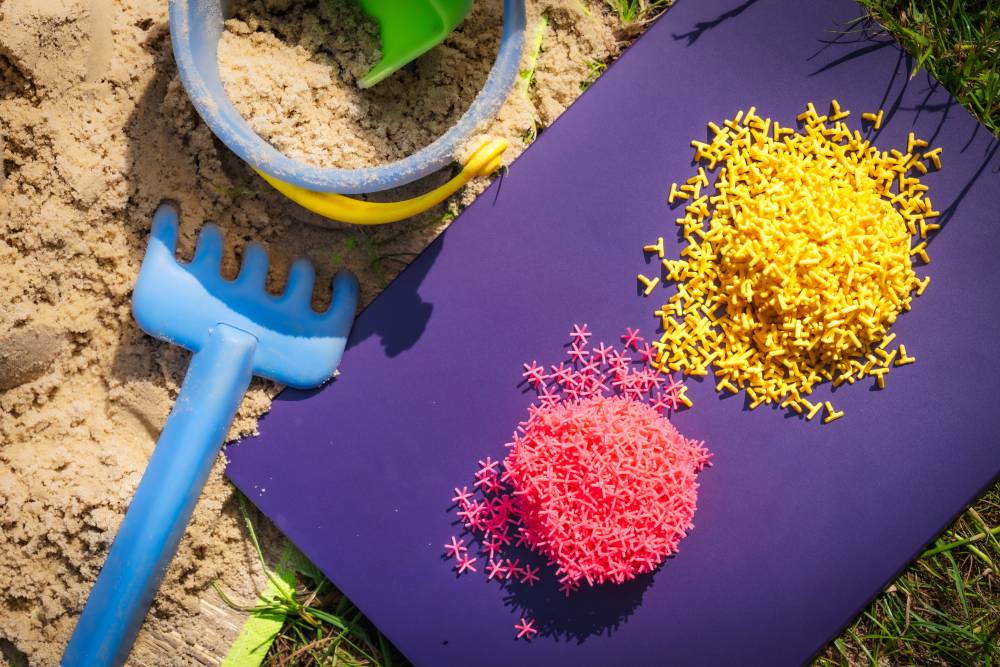
Real sand grains are irregular and varied. Modeling every bump and edge and calculating how they would all interact would quickly overwhelm even powerful computers. Therefore, the researchers sought to investigate whether a single grain shape can sum up sand behavior.
“In this compromise, the key is to figure out which approximation is good enough to make graphical representations of sand look realistic,” says co-author Mickaël Ly, a postdoc in the Wojtan group.
By adjusting grain shapes, the team could explore how microscopic geometry changes the behavior of an entire pile. They presented their findings at the computer graphics conference SIGGRAPH Asia 2025.
“We developed an intuitive approach to model sand grains to be representative of physical reality,” says Wojtan.
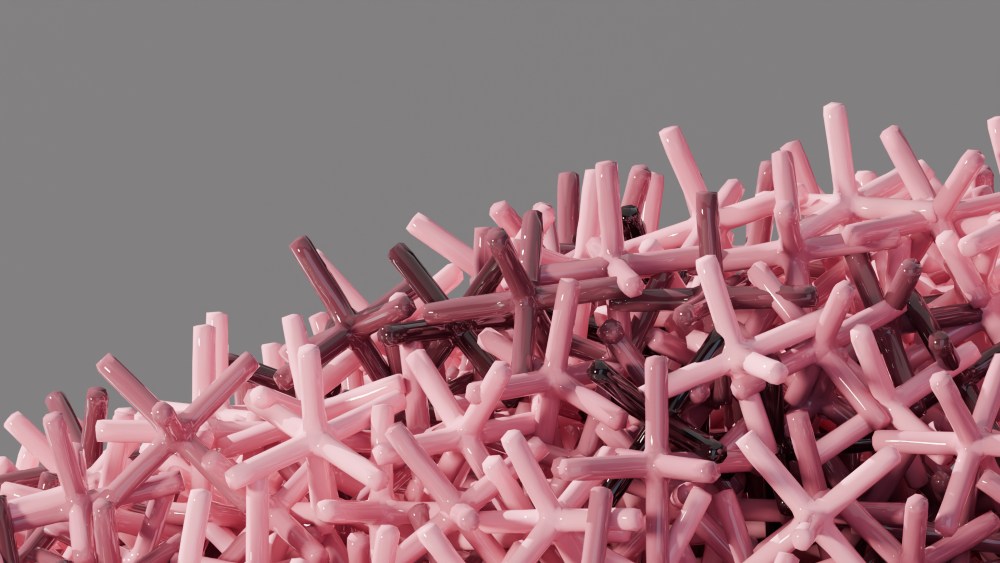
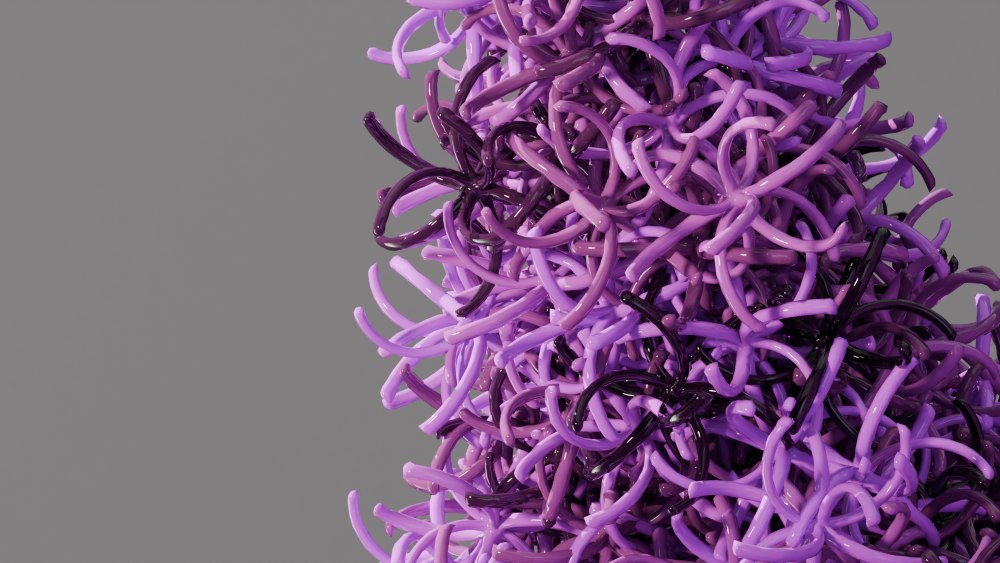
Interlocking fangs and sand that ‘pushes back’
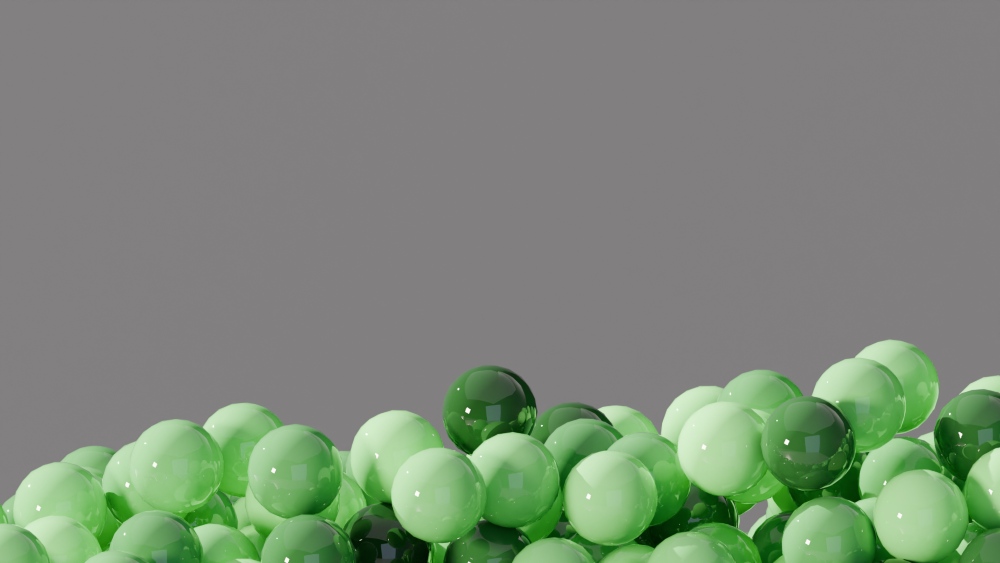
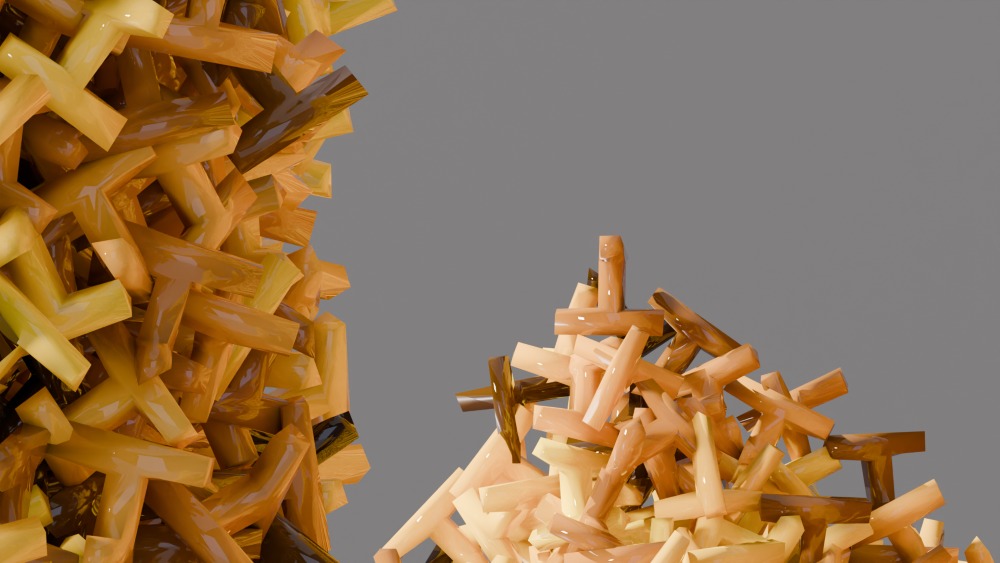
The researchers tested a family of grain shapes ranging from the simplest spheres to the most tangled structures. Smooth spheres roll and slide past one another easily. At the opposite extreme were “dodecafangs”—grains with twelve fang-like extensions that can become strongly entangled.
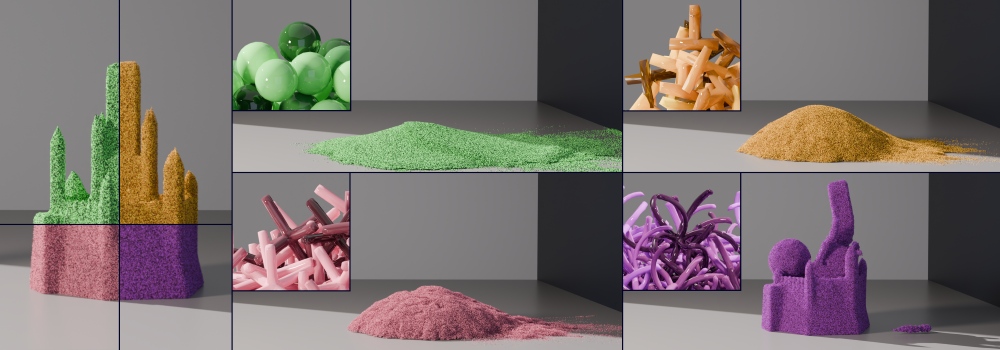
Their findings: A sandcastle made from dodecafangs would be unusually tough. It would resist collapse, and even hitting it with a ball of sand made from the same grains would cause only limited damage. Instead of falling apart like ordinary sand, the grains would behave more like a continuous elastic material.
Between these extremes, the team investigated other grain shapes with subtler behaviors. One shape, called “dolosse,” resembles a capital H rotated in three dimensions so that its bars do not lie in the same plane—inspired by the wave-dissipating concrete blocks with the same name used in coastal management. Despite the open gaps, dolosse-shaped grains do not interlock strongly. Instead, they slide over one another with only slightly more friction than smooth spheres.
Another shape—a six-legged grain known as the “hexapod”—produced especially striking behavior. Hexapods are not as cohesive as dodecafangs, but together they form sand that can hold its shape in surprising ways.
If a cup filled with hexapod sand is emptied onto a flat surface, the pile largely retains the cup’s shape. Pressing down on it with a hand does not make it immediately crumble. Instead, the sand seems to ‘push back.’
“With each shape, we can test the limits of our model,” says Wojtan. “What happens when the sand is compressed? How does it respond when stretched? When does it flow, and when does it lock into place?”
Toward cheaper digital dunes
The team’s work offers a new way to make large-scale sand simulations less computationally expensive and more realistic.
“In this study, we found a way to compress a large number of variables to be able to compute graphical representations of sand dramatically faster,” says Wojtan. “Only such an approach would be computationally achievable for a realistic representation of endless amounts of sand, like in the Dune movies.”
So far, the researchers have focused on predicting how sand behaves when a pile reaches its final resting state. Next, they want to study the moments in between—when sand pauses, shifts, and continues moving after a temporary equilibrium. These intermediate states are crucial for modeling dynamic events such as avalanches.
“Scientists have continuously proposed new models to better match observations of large-scale natural phenomena such as rockslides or avalanches. However, trying to adapt models from the grain-up remains uncommon,” says Ly.
For now, the ISTA team’s work remains basic research rather than a ready-to-use tool. But the team has developed an algorithmic toolkit that also allows other scientists to tune grain shapes and study how those shapes influence sand behavior in graphical simulations.
“Besides making our code and data available to the scientific community, our present work also provides design guidelines for future tools to model sand,” says Chen. “To simulate sand effectively, it turns out the key question is deceptively simple: What shape is a grain?”
Publication:
Yi-Lu Chen, Mickaël Ly and Chris Wojtan. 2025. Numerical Homogenization of Sand from Grain-level Simulations. ACM Transactions on Graphics. DOI: 10.1145/3763344
Funding information:
This research was supported by the Scientific Service Units (SSU) of ISTA through resources provided by Scientific Computing and was funded in part by the European Union (ERC-2021-COG 101045083 CoDiNA).