July 22, 2026
Infinite Deformation and Shape Computation
ISTA scientists present two computer graphics papers at SIGGRAPH 2026
This year, researchers from the Institute of Science and Technology Austria (ISTA) are presenting two papers at SIGGRAPH in Los Angeles—a leading annual computer graphics conference organized by the Association for Computing Machinery (ACM). One paper introduces new methods for texturing highly deformable surfaces, and the other proposes a faster, more precise way to compute geometric properties of shapes. Both show how to boost graphics accuracy while cutting computational cost, with potential applications across video gaming, visual effects, and simulation.
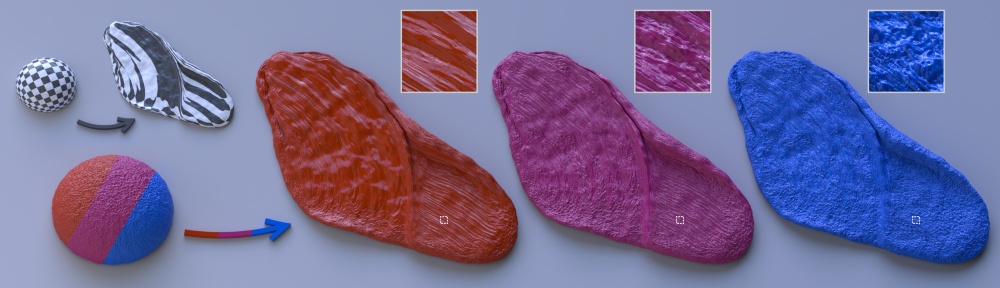
Representing Extremely Deformable Surfaces
To create realistic movies, producers often use 3D modeling to build reusable digital representations of objects. The artistic challenge is to make these digital models look lifelike. In animated models, objects without a distinct shape at rest are particularly challenging to represent.
In a study presented at this year’s SIGGRAPH, PhD student and first author Aleksei Kalinov and colleagues from Professor Chris Wojtan’s group at the Institute of Science and Technology Austria (ISTA) sought to represent extremely deformable surfaces more realistically while cutting computational costs. To do so, they took inspiration from nature.
“If a feature is preserved when natural systems such as lava or cake batter are deformed, we consider that nature ‘likes’ it and that it’s an ‘allowed’ texture feature,” Wojtan explains. “We then try to come up with nature-inspired rules that are cheap to compute.”
Ultimately, the team aims to achieve flicker-free, realistic representations with seamless details when modeling deformable surfaces by preserving or restoring ‘allowed’ texture features.
From cake batter to computer graphics
While mixing cake batter, air bubbles appear. But instead of an air bubble stretching infinitely—as an image might when one keeps zooming in—the batter’s surface eventually ruptures and forms new features as mixing continues.
To visually represent this process, the team modeled the textures using physical parameters such as frequency and amplitude rather than in terms of pixels.
In fact, stretching does not actually erase surface features. Rather, only the high-frequency information is lost and replaced with low-frequency information as the surface is stretched. In other words, the stretched surface ‘regenerates’ the information it carries, but at a lower frequency. This process can be reversed, bringing back the initial high-frequency surface information.
Compression has the opposite effect: high-frequency detail replaces the lost low-frequency information of the surface’s resting state. However, compressing a surface infinitely can make high-frequency information finer than the pixel size, leading to flickering—a phenomenon that computer scientists call aliasing.
“To overcome this risk of causing aliasing, our graphical models must feature an automatic process that prevents the details from reaching excessively high frequencies,” says Wojtan. “Taking inspiration from nature, we see what features are found in similar systems and add them back. Our method becomes more natural by acting as a restoring force in frequency space.”
Tackling persistent graphics problems
The team developed two modeling approaches that overcome the limitations of existing surface deformation models in two different ways. Their “spectrum-rescaling algorithm” restores high‑frequency details consistent with the deformation. On the other hand, the “isotropy-preserving method” aims to counteract deformation and preserve the initial texture. Both are fully procedural algorithms that generate information automatically, without physics simulations or stored deformation history. As a result, they considerably reduce computational costs.
Ultimately, these techniques could be applied in visual effects, video games, and simulation software. However, the team’s research focuses on more fundamental principles.
“We seek to develop fundamentally different ways of modeling nature through a wave-based rather than a picture-based approach,” Wojtan sums up. “The models we present in this work might not yet be fully polished for concrete applications. However, these approaches tackle long‑standing graphics problems from a new angle while keeping computational costs low.”
Like a Robot Vacuum Exploring a New Room
How does a computer perceive and interpret a shape? Much like a robotic vacuum scanning a new room, a computer exploring a shape from a single reference point will seek to map all the edges it can ‘see’ to understand whether it is enclosed within the shape or if there is a way out. This approach evaluates a mathematical quantity called the ‘winding number,’ which determines whether a point lies inside or outside a shape.
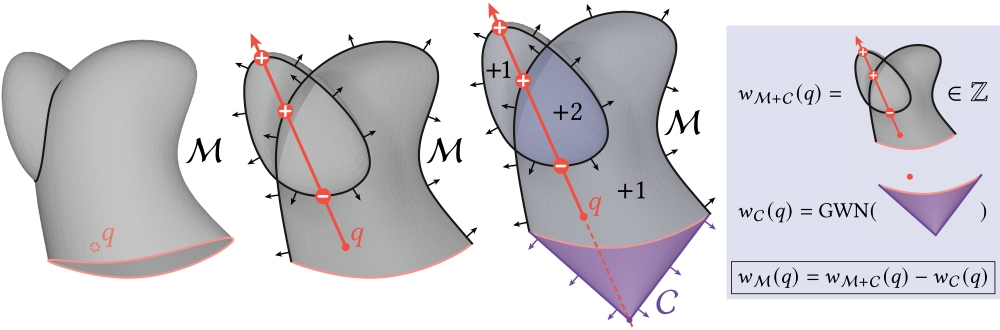
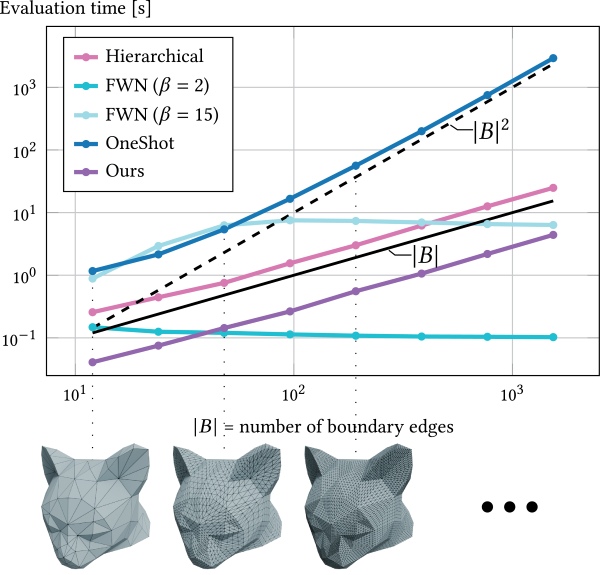
In another study presented this year at SIGGRAPH, PhD student and first author Peiyuan Xie and colleagues from the Wojtan group at ISTA developed a method to compute complex shape properties far more efficiently—reducing computational cost by an order of magnitude.
Instead of scaling with the entire surface area, the computation depends only on the boundaries—the points where surfaces end or connect.
“If the computer recognizes that the surface around the reference point is closed, calculating the shape becomes straightforward and inexpensive,” says Wojtan.
A key feature of this method is that the winding number of two adjacent surfaces that share a boundary is additive. Ultimately, the winding number of an ‘open’ shape, which would normally be expensive computationally, can therefore be calculated cheaply and quickly. To do so, the researchers construct a simple auxiliary shape that connects to the boundaries of the unknown open shape, resulting in an easy-to-compute closed shape. Subtracting the known winding number of the auxiliary shape gives the winding number of the open shape.
Publications:
Aleksei Kalinov, Mickaël Ly, Christian Hafner, Chris Wojtan. 2026. Physics-Inspired Procedural Texturing of Extremely Deformable Surfaces. ACM Transactions on Graphics. DOI: 10.1145/3811353
Peiyuan Xie, Christian Hafner, Chris Wojtan. 2026. Fast and Exact Winding Numbers for Triangle Meshes. ACM Transactions on Graphics. DOI: 10.1145/3811339
Funding information:
The project by Aleksei Kalinov et al. was supported by the Scientific Service Units (SSU) of ISTA through resources provided by Scientific Computing and was funded in part by the European Research Council (ERC Consolidator Grant 101045083 CoDiNA).
The project by Peiyuan Xie et al. was funded in part by the European Research Council (ERC Consolidator Grant 101045083 CoDiNA).